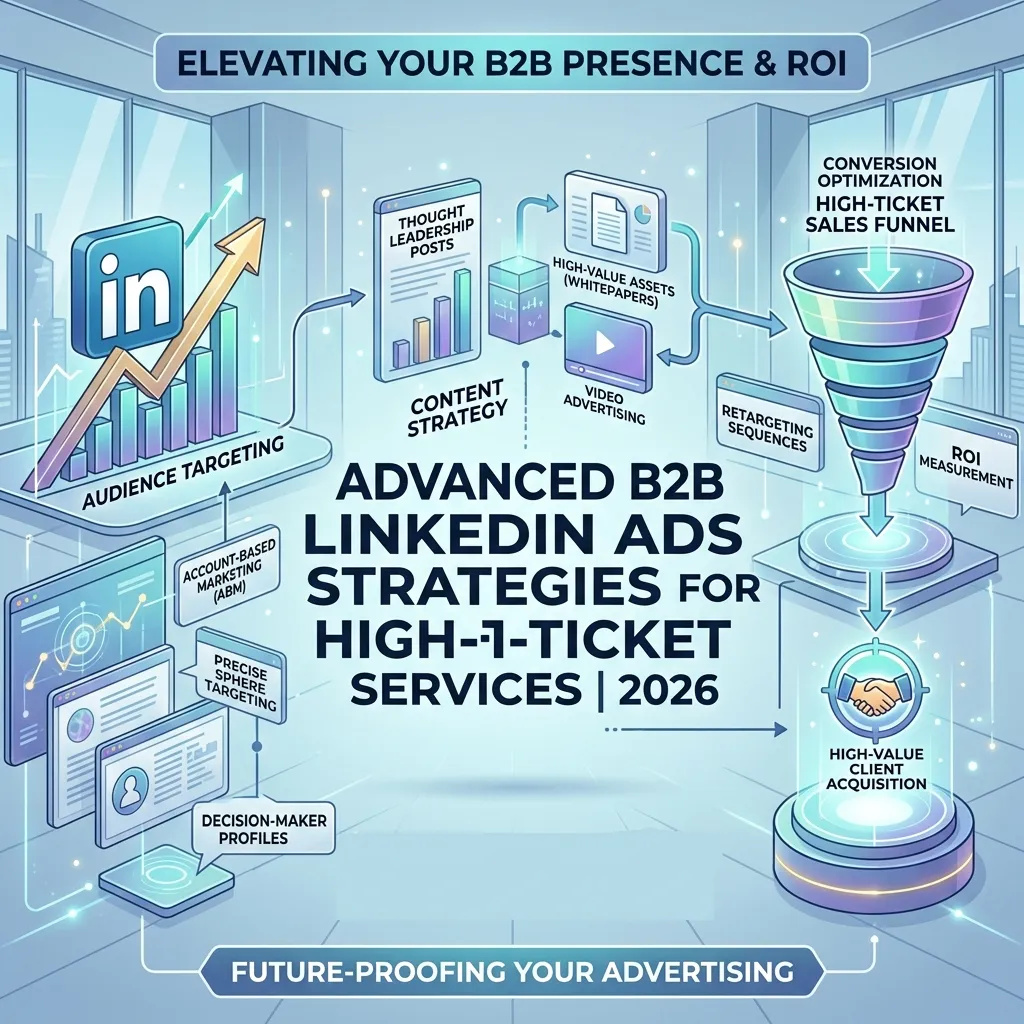
Advanced B2B LinkedIn Ads Strategies for High-Ticket Services in 2026
If you run a B2B business selling high-ticket services, you already know that generic marketing advice falls flat. You cannot sell a $50,000 enterprise software contract or a $10,000-a-month retainer the same way someone sells a $20 t-shirt on Instagram. The sales cycles are long, multiple decision-makers are involved, and logic plays a much heavier role than impulse. If you want to capture demand in this space, you need a platform where professionals actually spend their time looking for solutions. That platform is LinkedIn. But running LinkedIn ads successfully in 2026 requires an entirely different playbook than it did even two years ago.
This guide will break down the exact strategies, frameworks, and campaign architectures that work right now for high-ticket B2B services. Whether you are an agency owner, a SaaS founder, or a consultant, these are the methods you need to implement to stop burning budget and start driving qualified enterprise leads.
Before we dive into the technical campaign structures, it helps to understand why certain approaches succeed while others fail. This is something we specialize in at the Best Performance Marketing Agency in Chennai. We have seen firsthand how aligning your offer with the platform's intent changes everything.
1. The Reality of the 2026 LinkedIn Ads Ecosystem
LinkedIn is expensive. There is no getting around that fact. Cost-per-click (CPC) rates are significantly higher than Meta or Google Search. But complaining about the cost of a click misses the entire point of B2B marketing. You are not optimizing for cheap clicks; you are optimizing for revenue. A $15 click that turns into a $50,000 contract is vastly superior to a $1 click that yields nothing but spam submissions.
The platform has matured heavily. The days of throwing up a generic lead generation form and offering a vague whitepaper are gone. Buyers are fatigued. They guard their contact information closely, and they ignore superficial offers. To win on LinkedIn today, your advertising must act as an extension of your high-ticket sales process. It must educate, establish authority, and de-risk the purchasing decision before the prospect ever speaks to your sales team.
In 2026, the algorithm heavily favors relevance and engagement over broad targeting. LinkedIn wants to keep users on the platform consuming high-value content. Advertisers who understand this dynamic are using native formats like Document Ads and in-feed video to build trust over time, rather than demanding an immediate conversion on the first touchpoint.
2. Account-Based Marketing (ABM) Evolution
Account-Based Marketing is not a new concept, but the way we execute it on LinkedIn has shifted dramatically. In the past, advertisers would upload massive lists of companies and hope their ads reached the right people inside those organizations. Today, the approach is hyper-surgical.
The strategy now revolves around "Micro-ABM." Instead of targeting 5,000 companies, you target the top 200 accounts that represent the highest potential contract value. You then segment the buying committee within those accounts. For a high-ticket enterprise service, the buying committee typically consists of a Champion (the person who will use your service), a Decision Maker (the executive who approves the budget), and a Blocker (often IT or procurement who assesses risk).
Your ad strategy must serve different messages to different members of the same buying committee.
For the Champion, your ads should highlight ease of use, workflow improvements, and specific pain points your service eliminates. For the Decision Maker, the creative must focus strictly on ROI, cost savings, and high-level strategic advantages. For the Blocker, you need case studies proving security, compliance, and seamless integration. You can achieve this by creating separate campaigns using Job Title or Seniority targeting layered over your specific company list. This level of granularity ensures that when your sales team finally reaches out, every stakeholder has already been primed with the arguments that matter most to them.
3. Predictive Audience Targeting
Targeting is the foundation of any LinkedIn campaign. If your targeting is wrong, the best ad copy in the world will not save you. While native targeting features like Job Title, Industry, and Company Size remain useful, they are often too broad for high-ticket services.
In 2026, successful B2B advertisers are leveraging Predictive Audience Targeting. This involves using intent data providers to identify companies that are actively researching solutions in your category. Instead of targeting all companies that fit your ideal customer profile, you only target the ones showing active buying signals.
You take this intent data, upload the company list to LinkedIn, and then apply your persona targeting (e.g., VP of Marketing, CTO, Director of Operations). This ensures your expensive ad budget is only spent on accounts that are already in the market for what you sell.
Furthermore, you must rigorously use exclusions. Exclude your current clients. Exclude competitors. Exclude junior employees who have no purchasing power. Exclusion lists are just as critical as your inclusion lists because they protect your budget from being wasted on inevitable dead ends.
4. Structuring Offers for High-Ticket Services
The biggest mistake B2B advertisers make is asking for a marriage on the first date. If your service costs $100,000 a year, you cannot run an ad to a cold audience asking them to "Book a Demo" or "Buy Now." The friction is too high.
Instead, you need a tiered offer structure.
Low-Friction Offers (Top of Funnel): These are designed to capture attention and provide massive value in exchange for a sliver of contact information. Examples include proprietary industry reports, comprehensive benchmark data, or ungated thought leadership videos. The goal here is not to sell; it is to prove competence. If your free content is better than your competitor's paid consulting, you immediately establish authority.
Mid-Friction Offers (Middle of Funnel): Once a prospect has engaged with your low-friction offer, you move them to the next stage. Mid-friction offers require more time and commitment from the prospect. These include on-demand webinars, interactive ROI calculators, or specific case study breakdowns that mirror the prospect's exact industry.
High-Friction Offers (Bottom of Funnel): Only after a prospect has consumed multiple pieces of your content do you present the high-friction offer. This is the "Book a Strategy Session," "Request a Custom Audit," or "Schedule a Demo" call to action. Because you have already educated the prospect and built trust over time, the conversion rate on these high-friction offers will be significantly higher than if you pitched them cold.
5. Ad Creative and Copywriting Psychology
B2B buyers are humans. They are not robots devoid of emotion. While they need logical justification (ROI, efficiency, growth) to make a purchase, the initial hook must capture their human attention.
Your ad copy must immediately call out their specific pain point. Instead of writing, "We provide premium logistics consulting," write, "Are supply chain bottlenecks eating 15% of your quarterly profit?" The latter addresses a specific pain that a logistics executive feels every single day.
Keep your copy formatting clean. Use short paragraphs. B2B buyers are busy; they skim. State the problem, introduce your unique mechanism for solving it, and provide a clear call to action.
For visual creative, avoid generic stock photos of people pointing at laptops or shaking hands. These signal to the brain that this is an advertisement, and people naturally ignore advertisements. Use native-looking assets. Text-based graphics that highlight a single, powerful statistic perform exceptionally well. Screenshots of dashboards showing actual results, charts detailing a before-and-after scenario, or simple, high-contrast text graphics that ask a provocative question are the formats driving the highest engagement in 2026.
6. The Document Ad Framework
Document Ads are currently one of the most underutilized and powerful formats on LinkedIn. They allow users to scroll through a PDF presentation directly in their newsfeed without leaving the platform.
This format is perfect for high-ticket B2B marketing because it allows you to deliver a substantial amount of information in a digestible, low-commitment way.
To build a high-converting Document Ad, follow this framework: - Slide 1 (The Hook): A bold claim or a specific question calling out your ideal buyer. - Slide 2 (The Agitation): Why their current approach is failing or costing them money. - Slide 3 - 5 (The Education): The framework or system you use to solve the problem. Give away the strategy for free. - Slide 6 (The Proof): A specific metric or case study showing how this framework worked for a similar company. - Slide 7 (The Call to Action): Tell them exactly what to do next (e.g., download the full report, visit your site, or message you directly).
Because users spend significant time reading through the slides, the algorithm views this as high-quality engagement and rewards the ad with better reach and lower costs.
7. Lead Gen Forms vs. Landing Pages
The debate between native LinkedIn Lead Gen Forms and directing traffic to an external Landing Page is ongoing, but the data points to a clear strategy depending on your specific goals.
When to use Lead Gen Forms: Use native forms for top-of-funnel offers. If you are offering a whitepaper or a template, you want the lowest possible friction. LinkedIn pre-fills the user's data (name, email, job title), meaning they can convert in two clicks without waiting for a website to load. This will always result in a lower cost-per-lead (CPL). However, the intent of these leads is generally lower.
When to use Landing Pages: Use external landing pages for bottom-of-funnel offers. If you want someone to book a $10,000 consulting call, you need them to read your long-form copy, see your video testimonials, and understand your entire value proposition. The friction of clicking away from LinkedIn, waiting for the page to load, and manually typing in their information acts as a filter. You will get fewer leads, but the leads you do get will be highly qualified and ready to buy.
8. Retargeting Sequences and Sales Velocity
If you are only running cold campaigns on LinkedIn, you are leaving 80% of your revenue on the table. High-ticket B2B sales require multiple touchpoints - often 15 to 20 - before a prospect feels comfortable initiating contact.
Your retargeting sequence must be deliberate. It should not just show the exact same ad over and over again. You must move the prospect through a logical narrative.
The 30-Day Retargeting Sequence: - Days 1 to 10: Retarget people who visited your website or engaged with your cold ads. Show them educational content. Share a video of your founder explaining a complex industry problem. Build affinity and trust. - Days 11 to 20: Shift the messaging to social proof. Show video testimonials from past clients. Display case study metrics. Prove that you have solved this problem for companies just like theirs. - Days 21 to 30: Transition to a direct call to action. Offer a strategy session or a customized audit.
This sequenced approach ensures you stay top-of-mind without causing ad fatigue, effectively compressing the sales cycle and increasing your overall sales velocity.
9. Integrating Offline Conversions API
One of the biggest advancements for B2B marketers in recent years is the widespread adoption of the Conversions API. In a high-ticket environment, the actual transaction never happens online. A lead might fill out a form on LinkedIn today, but the $100,000 contract might not be signed for another six months, after multiple sales calls and negotiations.
If you rely solely on pixel tracking, the ad platform only sees the initial form fill. It treats a form fill that resulted in a closed deal exactly the same as a form fill from an unqualified student doing research.
By integrating your CRM (like Salesforce or HubSpot) directly with LinkedIn via the Conversions API, you can send downstream data back to the platform. When a lead moves to the "Qualified Opportunity" stage in your CRM, that signal is sent back to LinkedIn. When a deal is marked "Closed Won," the exact revenue value is passed back to the campaign that generated the initial click six months ago.
This allows the algorithm to optimize not just for cheap leads, but for actual pipeline revenue and closed deals. It is the single most important technical implementation for scaling high-ticket campaigns.
10. Budgeting, Bidding, and Scaling Strategies
Scaling B2B campaigns requires a steady hand. You cannot double your budget overnight and expect your cost-per-acquisition to remain stable.
When launching a new campaign, start with a budget that allows for at least a few conversions per week so the algorithm has data to work with. For bidding, manual CPC is often the safest choice during the initial testing phase. It gives you complete control over how much you are willing to pay to reach your specific audience.
Once a campaign is proven and generating qualified pipeline, you can switch to automated bidding strategies like Maximum Delivery to scale spend. However, when you increase budgets, do so incrementally - by 15% to 20% every few days. This prevents the algorithm from panicking and bidding aggressively on low-quality inventory just to spend your daily limit.
Always monitor frequency (how often the same person sees your ad). For cold audiences, a frequency of 2 to 3 over a 30-day period is ideal. For retargeting audiences, a frequency of 5 to 7 is acceptable. If frequency gets too high, costs will spike, and you risk annoying your ideal prospects. At that point, you must refresh your creative.
11. Competitor Interception Tactics
One of the most aggressive and effective strategies in B2B marketing is competitor interception. If a prospect is actively researching your competitors, they are a high-intent buyer.
While you cannot target people who search for competitor names on LinkedIn the way you can on Google Search, you can use workarounds. You can target the followers of competitor company pages (though this is increasingly restricted, there are indirect ways to model this audience).
A more reliable method is targeting the specific skills, groups, and certifications associated with your competitor's proprietary software or methodologies. If someone lists "Salesforce Administration" as a skill, and you sell a competing CRM, they are a prime target.
When running competitor interception campaigns, your ad copy must clearly articulate your unique value proposition and why your solution is vastly superior to the legacy option they are currently using. Use comparison charts (e.g., "Us vs. Them") to make the differences immediately obvious.
12. Video Marketing on LinkedIn
Text and images are foundational, but video builds trust faster than any other medium. In the context of high-ticket B2B services, trust is the ultimate currency. If a prospect feels like they know your leadership team before they even jump on a sales call, the close rate skyrockets.
Your video strategy should not consist of highly produced, corporate commercials with stock music and voiceovers. Those perform terribly.
The best performing videos are raw, authentic, and educational. Use a smartphone or a decent webcam. Have your subject matter experts speak directly to the camera about a specific, nuanced problem your industry faces. This format, often called "founder-led content," cuts through the corporate noise. It proves that there are real, intelligent humans behind the brand.
Keep these videos under two minutes. Use hardcoded captions because the majority of users watch video on mobile with the sound off. And most importantly, do not pitch your service until the very last five seconds. Provide 95% value and 5% pitch.
13. B2B Funnel Mapping
A common failure point is a disjointed funnel. Marketing runs an ad, the prospect clicks through to a landing page that looks completely different from the ad, and then receives an automated email that sounds like it was written by a different company. This breaks trust instantly.
Funnel mapping ensures consistency across every touchpoint.
- The Ad: The visual style and the core promise (the hook).
- The Landing Page: Must instantly reinforce the core promise from the ad. The headline on the landing page should mirror the headline in the ad copy.
- The Lead Magnet: The deliverable must actually solve the problem promised. Do not bait-and-switch.
- The Follow-up Sequence: The first email should deliver the asset. The second email should expand on the concepts in the asset. The third email should offer a consultation.
Every step must feel like a natural progression of a single conversation. If a prospect is targeted because they are a CFO in the manufacturing sector, the ad, the landing page, and the emails must all explicitly address manufacturing finance. Specificity converts.
14. Alignment Between Sales and Marketing Teams
In high-ticket B2B, marketing and sales cannot operate in silos. If marketing generates 500 leads but sales rejects 490 of them as unqualified, the campaign is a failure, regardless of how cheap the cost-per-lead was.
To fix this, implement a closed-loop feedback system. Marketing and sales must meet bi-weekly to review the leads generated by LinkedIn. Sales must provide qualitative feedback: Were the leads too junior? Did they misunderstand the pricing model? Did they have the right technical infrastructure?
Marketing uses this feedback to adjust the LinkedIn targeting, update the exclusion lists, and refine the ad copy to pre-qualify prospects better. If leads are consistently balking at price, marketing needs to inject pricing transparency into the middle-of-funnel content to filter out tire-kickers earlier in the process.
This alignment ensures that the marketing budget is directly tied to closed revenue, not vanity metrics.
15. Advanced Analytics and Attribution Models
Last-click attribution is essentially useless for high-ticket B2B services. If a CEO sees your LinkedIn ad on her phone while commuting, reads your thought leadership, but doesn't click, you have influenced her. A week later, she tells her assistant to search for your company on Google and book a consultation. Under last-click attribution, Google Organic gets 100% of the credit, and the LinkedIn campaign looks like a failure.
To scale properly in 2026, you must adopt multi-touch attribution and self-reported attribution.
Multi-Touch Attribution: Use software to track the entire buyer journey, assigning fractional credit to every touchpoint (the initial LinkedIn ad, the retargeting video, the organic search, the direct email).
Self-Reported Attribution: On your "Book a Demo" form, make "How did you hear about us?" a required, free-text field. You will be shocked at how often prospects write "saw your videos on LinkedIn," even if your analytics software claims they came from a direct search. This qualitative data is invaluable for defending your ad spend and understanding what is actually driving awareness.
16. The Role of Content Syndication
Beyond direct response ads, LinkedIn is a powerful platform for content syndication. If your company produces high-quality long-form content - like comprehensive industry reports or original research - you can use LinkedIn to amplify its reach to specific decision-makers.
Content syndication campaigns work best when you target individuals who are naturally curious about industry trends. By gating a massive, high-value report behind a lead gen form, you capture contact information from professionals actively educating themselves.
Once they download the report, they enter a specialized email nurture sequence. Because you know exactly what topic interested them, your follow-up emails can be hyper-relevant, slowly introducing how your high-ticket service practically applies the theories discussed in the report.
17. Navigating LinkedIn's Bidding Auctions
The LinkedIn ad auction is based on relevance and bid. You are not just bidding against direct competitors; you are bidding against anyone else trying to reach that same individual. If you are targeting a VP of IT, you are competing with cybersecurity firms, cloud hosting providers, and enterprise hardware sellers.
This means you must maintain a high click-through rate (CTR). A high CTR signals to LinkedIn that your ad is relevant, which improves your quality score and ultimately lowers your CPC.
If your CTR drops below 0.4% for sponsored content, your ad is likely experiencing fatigue or your targeting is fundamentally disconnected from your creative. You must pause underperforming ads quickly and cycle in fresh creative. Constantly testing new headlines, new visuals, and new formats is the only way to survive the auction dynamics over the long term.
18. Creating a Moat with Thought Leadership
Advertising buys you attention, but thought leadership buys you trust. The most successful high-ticket B2B campaigns do not just rely on company page ads. They amplify the personal profiles of the company's executives.
LinkedIn allows you to run Thought Leader Ads, where you can sponsor a post made by an individual employee or executive. This is incredibly powerful. People prefer buying from people, not faceless corporations.
When you sponsor an insightful, industry-specific post written by your CEO and target it at your ABM list, it bypasses the natural skepticism people have toward traditional ads. It positions your leadership as industry experts. When the prospect eventually enters a sales conversation, they already view your team as authoritative voices, shifting the dynamic from a vendor pitch to an expert consultation.
19. The Importance of Speed to Lead
In the B2B space, momentum is fragile. If a prospect fills out a lead form requesting a consultation, their intent is at its absolute peak in that exact moment. If your sales team waits 48 hours to reach out, that intent has evaporated. They have likely researched your competitors or moved on to other pressing fires in their business.
You must integrate your LinkedIn campaigns with your CRM so that the moment a lead form is submitted, a notification goes directly to the appropriate sales rep via email or Slack. The goal should be to initiate contact within 15 minutes of the submission.
This rapid response time drastically increases the probability of booking the meeting and ultimately closing the deal. High-ticket sales require operational excellence just as much as marketing brilliance.
20. Leveraging First-Party Data for Lookalike Expansion
As privacy regulations tighten and third-party cookies become less reliable, your first-party data is your most valuable marketing asset. If you have a CRM filled with thousands of historical clients, unconverted leads, and active newsletter subscribers, you can upload this directly into LinkedIn to create highly accurate Lookalike Audiences.
However, you must be careful. Building a Lookalike Audience off your entire database is a mistake. Your database likely includes unqualified leads, bad fits, and churned customers. If you build a Lookalike based on that data, LinkedIn will simply find more unqualified leads for you.
Instead, segment your CRM data before uploading. Create a specific list containing only your top 20% most profitable clients - the ones with the highest lifetime value and the shortest sales cycles. When you feed this highly refined list into LinkedIn, the algorithm models its Lookalike Audience against the exact specific traits, behaviors, and firmographics of your absolute best buyers. This ensures you are expanding your reach into a pool of prospects who closely mirror your ideal customer profile, drastically improving the efficiency of your cold outreach campaigns.
21. A/B Testing Protocols for Enterprise Ads
A/B testing is mandatory, but testing random elements without a hypothesis is a waste of money. If you test a blue button versus a red button on a B2B landing page, you are wasting time. You need to test elements that fundamentally change how the prospect perceives your offer.
Start by testing the core hook. Run two identical ads with completely different headlines. One headline might focus on risk mitigation (e.g., "Stop Losing 20% of Your Supply Chain Budget to Inefficiencies"), while the other focuses on growth (e.g., "Scale Your Supply Chain Volume by 20% Without Adding Headcount"). Once you have a statistically significant winner, you have learned what psychological trigger motivates your specific audience.
Next, test the ad format. Take your winning message and run it as a Single Image Ad, a Video Ad, and a Document Ad simultaneously. B2B audiences consume information differently. Some executives prefer to read a detailed PDF, while others will stop to watch a 60-second video clip.
Finally, test your friction levels. If your CPL (Cost Per Lead) is too high on your "Book a Consultation" offer, test a lower-friction offer like a "Custom Pricing Audit" to see if the reduction in commitment increases lead volume without sacrificing lead quality. Rigorous, methodical A/B testing is what separates profitable campaigns from campaigns that simply burn cash.
22. Designing Post-Click Experiences
The ad itself is only responsible for the click. The post-click experience is responsible for the conversion. If a prospect clicks on an ad promising a deep dive into enterprise software implementation, but they land on a generic homepage, they will bounce immediately.
Your landing pages must be hyper-specific. If you are targeting the healthcare sector with your LinkedIn ads, the landing page must feature healthcare case studies, healthcare terminology, and testimonials from healthcare executives. The cognitive load on the prospect should be zero; they should instantly recognize that they are in exactly the right place.
Ensure your landing page load speeds are instantaneous. Mobile optimization is critical, as a significant portion of LinkedIn traffic occurs on mobile devices during commutes or downtime. If your page takes more than three seconds to load, you are losing expensive clicks before they even see your headline.
23. Conclusion: Playing the Long Game
Scaling high-ticket B2B services via LinkedIn Ads in 2026 is not about finding a secret hack or a hidden targeting trick. It is about fundamentally respecting the complexity of the enterprise buying cycle.
It requires deep, surgical targeting. It demands creative that educates and de-risks the decision. It relies on a sequenced, logical retargeting strategy that mirrors the sales process. And above all, it requires absolute alignment between what the marketing team promises and what the sales team delivers.
If you commit to building a comprehensive, full-funnel architecture, LinkedIn will transform from an expensive line item into the most predictable and scalable revenue engine in your business.
Last updated: 2026-10-05