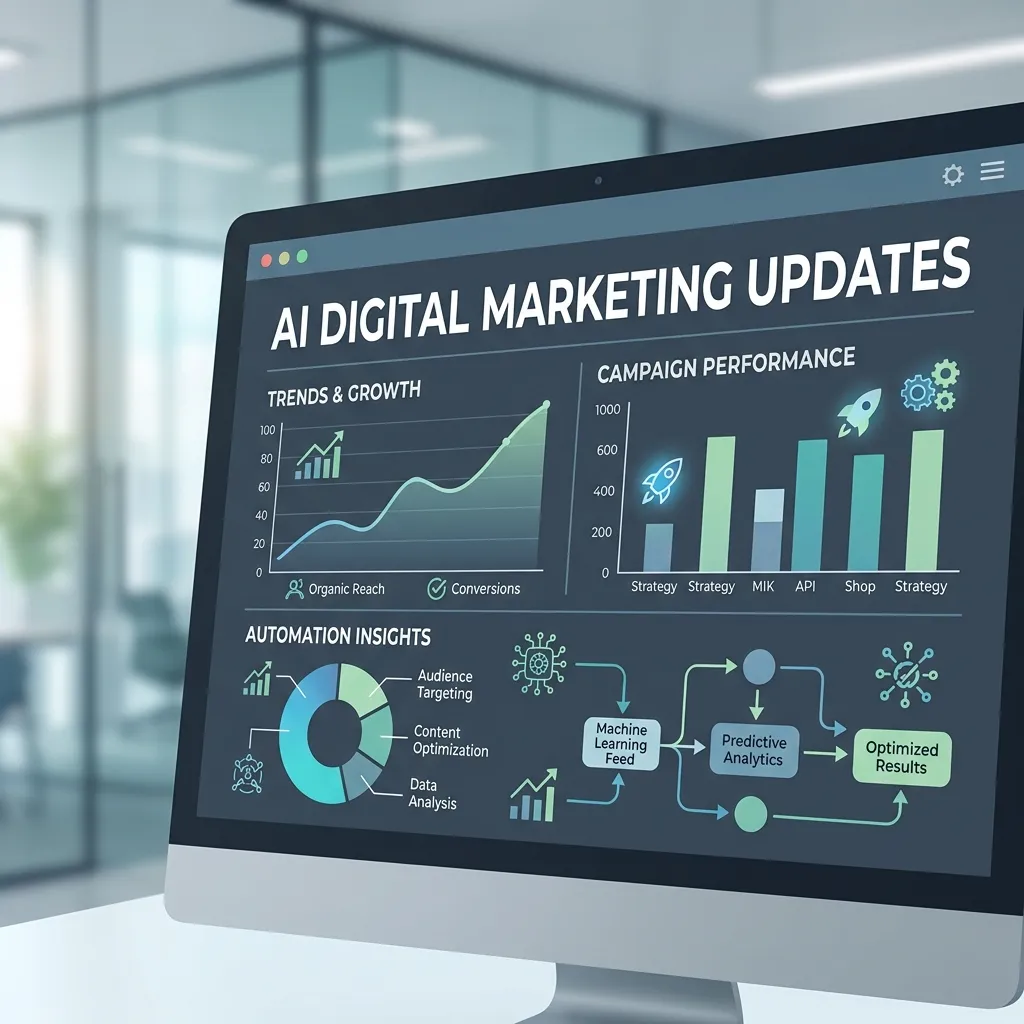
The 2026 Guide to AI, Agentic AI, and Digital Marketing Updates
Agentic AI and generative search have transformed digital marketing in 2026, fundamentally altering the way businesses interact with their customers. The focus has decisively shifted from keyword stuffing and aggressive lead capture forms to action-driven user journeys and highly personalized, autonomous experiences. Businesses that fail to adapt to these new paradigms risk obsolescence. Partnering with a Best Performance Marketing Agency in Chennai ensures you navigate these complex updates effectively and drive measurable, sustainable return on investment.
This comprehensive guide explores the critical updates defining the digital landscape this year. We will examine the shift from generative models to autonomous agents, the rise of Answer Engine Optimization, the mechanics of predictive performance marketing, and the necessary evolution of the modern marketing tech stack.
The Evolution: From Generative to Agentic AI
To understand the marketing landscape in 2026, we must first understand the distinction between Generative AI and Agentic AI. For the past few years, marketers have relied on generative models to assist with content creation. You provided a prompt, and the AI generated an image, a blog post, or a string of ad copy. The output was static, and the human operator was entirely responsible for deploying and managing that asset.
Agentic AI represents a massive leap forward. These systems do more than assist; they act. They possess agency. When deployed in a marketing context, an Agentic AI system can independently formulate a plan, execute the necessary steps across multiple platforms, monitor the real-time results, and adjust its strategy without continuous human intervention.
Autonomous Campaign Management
Consider the traditional workflow of a media buying team. They launch a campaign on Meta Ads, monitor the cost-per-click, pause underperforming creatives, and shift budgets to the best-performing audiences. This process requires constant vigilance and is limited by human processing speed.
In 2026, an Agentic AI handles this entire workflow autonomously. You define the overarching goal, such as acquiring qualified B2B leads at a maximum cost of $150. The Agentic AI analyzes historical CRM data, generates dozens of highly targeted ad creatives, deploys them across Meta and LinkedIn, and monitors the real-time conversion data. If a specific creative is driving cheap clicks but no qualified pipeline revenue, the AI autonomously pauses the ad. It learns, adapts, and executes at a scale that humans simply cannot match.
The Shift in Marketing Team Dynamics
The rise of Agentic AI does not eliminate the need for human marketers; it elevates their role. Instead of functioning as operators who push buttons and monitor spreadsheets, marketers must now act as strategic architects.
The human team is responsible for setting the constraints, defining the brand voice, and ensuring that the AI’s actions align with the company’s long-term business objectives. They establish the governance frameworks that prevent the AI from optimizing purely for short-term vanity metrics at the expense of brand equity. The modern agency provides the strategic oversight that guides these autonomous engines.
The Dominance of Answer Engine Optimization (AEO)
The traditional Search Engine Results Page (SERP) is largely unrecognizable in 2026. The integration of AI Overviews into platforms like Google, combined with the widespread adoption of AI search engines like Perplexity, has fundamentally changed how users find information.
Users no longer want a list of ten blue links; they want immediate, synthesized answers to their complex queries. This shift necessitates a transition from traditional Search Engine Optimization (SEO) to Answer Engine Optimization (AEO) and Generative Engine Optimization (GEO).
Structuring Content for LLMs
Generative engines do not evaluate content the same way traditional search crawlers do. They are looking for authoritative, highly structured data that they can easily parse and cite.
To rank in this new environment, your content must be structured using an answer-first methodology. If your target audience is asking, "What is the average customer acquisition cost in the SaaS industry?", you must provide a clear, concise answer in the very first sentence of the relevant section. Do not bury the answer under three paragraphs of context. Provide the answer immediately, and then use the subsequent text to provide deeper analysis, proprietary data, and case studies.
The Premium on Proprietary Data
AI models are trained on massive datasets comprising mostly publicly available information. If your website simply regurgitates the same generic advice found on fifty other blogs, the AI engine has no reason to cite you as a source.
To gain visibility in AI overviews, you must provide unique information. This means publishing original research, conducting surveys, sharing proprietary industry data, and offering distinct, contrarian expert opinions. When you provide data that cannot be found anywhere else, the AI engines are forced to cite your website as the primary source, driving highly qualified traffic to your domain.
Zero-Click Search Strategies
The rise of AI overviews has accelerated the trend of zero-click searches, where users get their answer directly on the search page without ever clicking through to a website. Many businesses view this as a threat, but it is actually a massive opportunity for brand building.
Even if the user does not click through to your site, having your brand consistently cited as the authoritative source by an AI engine builds immense trust and credibility. When that user is eventually ready to make a purchase, your brand is already positioned as the industry leader. The strategy shifts from maximizing raw traffic volume to maximizing brand impressions within AI-generated answers.
Predictive Analytics and Precision Targeting
Traditional digital marketing relies heavily on reactive data. You analyze past performance to determine future actions. In 2026, performance marketing is defined by predictive analytics.
Anticipating Consumer Behavior
Agentic AI systems utilize advanced machine learning algorithms to analyze millions of data points across the entire customer journey. By correlating browsing behavior, past purchases, email engagement, and external market signals, the AI can build highly accurate propensity models.
These models calculate the statistical probability that a specific user will take a specific action, such as making a purchase, churning, or upgrading to a higher service tier. This allows marketers to anticipate consumer behavior before it happens. Instead of waiting for a user to abandon their cart, the AI can identify a user with a high propensity to churn and autonomously serve them a targeted retention offer before they leave the site.
Dynamic Budget Reallocation
Predictive analytics also revolutionize budget management. Instead of rigidly allocating budget based on historical performance, Agentic AI manages budget fluidly across the entire digital ecosystem.
If the AI detects a sudden spike in high-intent search volume for a specific product category on Google, it can instantly reallocate budget from top-of-funnel Meta ads to capture that demand. This dynamic, real-time reallocation ensures that marketing dollars are always deployed where they have the highest probability of generating a return.
Reducing Ad Spend Waste
One of the most significant benefits of predictive targeting is the reduction of ad spend waste. Broad targeting strategies inevitably waste money reaching users who have zero intention of buying.
By focusing purely on high-propensity cohorts, businesses can drastically reduce their customer acquisition costs. A local retail brand struggling with high acquisition costs on Meta ads partnered with an expert agency to implement an Agentic AI bidding system. The AI tested dozens of creative variations and targeted specific micro-segments identified by the predictive model. Customer acquisition costs dropped by 28 percent within the first month, highlighting the financial efficiency of predictive targeting.
Multimodal Content Generation at Scale
In 2026, the concept of a single-channel marketing campaign is entirely obsolete. Consumers interact with brands across a fragmented landscape of text, audio, short-form video, and long-form content. Managing this fragmentation manually requires massive teams and exorbitant budgets. The solution is multimodal AI content generation.
The Unified Campaign Engine
Modern AI tools are no longer restricted to a single medium. An advanced Agentic AI system can take a single foundational asset, such as a whitepaper or a recorded webinar, and autonomously generate a cohesive, multimodal campaign.
From a single prompt, the AI can extract the key insights from the webinar and generate a comprehensive SEO-optimized blog post. It can simultaneously generate a thread of social media posts, draft a five-part email nurture sequence, and produce short-form video scripts. More advanced systems can even use voice cloning and AI avatars to fully generate the video and audio assets without requiring a human to step in front of a camera.
Maintaining Brand Consistency Across Mediums
The challenge with multimodal generation is maintaining a consistent brand voice and visual identity across drastically different formats. A disjointed brand experience erodes trust and decreases conversion rates.
This is where strict AI governance and carefully constructed prompt engineering become essential. Marketers must ensure that the foundational models are trained on the company’s specific brand guidelines, color palettes, and tone of voice documents. The AI must understand that the tone used in a B2B whitepaper will differ from the tone used in a TikTok ad, but both must remain fundamentally aligned with the core brand identity.
Speed to Market as a Competitive Advantage
The ability to generate high-quality multimodal content autonomously provides a massive competitive advantage in speed to market. When a new industry trend emerges, a traditional marketing team might take weeks to research, write, design, and launch a comprehensive campaign.
An Agentic AI system can synthesize the trend, generate the assets, and deploy the campaign across all channels within hours. In a fast-paced digital economy, the businesses that can react to market shifts and consumer demands the fastest are the ones that capture the majority of the market share.
Hyper-Localized AI Strategies for Brick-and-Mortar
While enterprise SaaS and global e-commerce brands often dominate the conversation surrounding AI, the technology is equally transformative for local brick-and-mortar businesses. In 2026, local search is entirely driven by conversational AI and hyper-localized intent.
The Rise of Conversational "Near Me" Searches
Users are no longer typing simple, fragmented queries like "plumber near me" into a search bar. They are speaking complex, conversational queries into voice assistants and AI engines. A query might sound like, "I need a highly rated emergency plumber open right now who can fix a burst pipe in downtown Chennai and accepts digital payments."
To capture this hyper-specific demand, local businesses must adopt a sophisticated approach to local SEO. This involves ensuring that every conceivable detail about the business—hours of operation, specific services offered, accepted payment methods, and precise service areas—is accurately represented across all digital directories and structured with the correct schema markup on the website.
Managing Local Reputation at Scale
In the era of AI search, online reviews are more critical than ever. AI engines heavily weigh customer sentiment when determining which businesses to recommend. A high volume of positive, detailed reviews is a primary ranking signal.
Agentic AI can assist local businesses in managing their reputation at scale. The system can autonomously monitor review platforms, alert business owners to negative sentiment, and even draft personalized, context-aware responses to customer feedback. By actively managing their digital reputation, local businesses ensure that the AI engines view them as the most credible and trustworthy option in their area.
Dynamic Localized Advertising
Agentic AI also allows local businesses to run highly efficient, localized advertising campaigns. A restaurant franchise with multiple locations can use an AI agent to autonomously manage the ad spend for each specific store.
If one location is experiencing a slow Tuesday evening, the AI can detect the dip in foot traffic and instantly deploy a hyper-targeted, time-sensitive promotion to users within a three-mile radius. It can dynamically adjust the ad copy to highlight the specific address and current wait times. This level of granular, localized optimization maximizes the ROI of every advertising dollar spent.
Common Pitfalls and the Path to Successful Integration
Despite the immense potential of Agentic AI, many businesses struggle to achieve a positive return on their investment. These failures are rarely due to the technology itself; they are almost always the result of poor strategy, inadequate infrastructure, or a fundamental misunderstanding of how the systems operate.
The Danger of Generic Implementation
The most common mistake businesses make is deploying off-the-shelf AI solutions without customizing them for their specific operational needs. If you plug a generic Agentic AI into your CRM and tell it to "optimize sales," you are inviting chaos.
The AI must be meticulously trained on your specific business rules, your target audience personas, and your historical performance data. Without this contextual understanding, the AI will make decisions that are technically optimized but strategically disastrous. For example, it might aggressively discount your premium products to drive short-term volume, permanently damaging your brand equity and profit margins.
The Alignment of Sales and Marketing
Agentic AI operates best when it has visibility across the entire revenue funnel. If your marketing data and your sales data reside in siloed systems, the AI is operating blindly.
For a B2B company, the marketing AI must know which leads actually closed and generated revenue, not just which leads clicked on an ad. If the systems are not integrated, the AI will continuously optimize for the cheapest leads, regardless of their actual quality. Successful integration requires a unified data architecture that aligns the marketing and sales departments around a single source of truth.
The Importance of Human Oversight
It bears repeating: AI is a tool, not a replacement for high-level strategic thinking. Businesses that completely abdicate their marketing responsibilities to an autonomous agent expose themselves to significant risk.
The most successful marketing operations in 2026 operate on a model of "human in the loop." The AI agent handles the heavy lifting of data analysis, bid optimization, and creative variation testing. The human team monitors the high-level performance, audits the AI’s decisions, and provides the strategic guardrails that keep the system aligned with the brand’s core values.
Restructuring the Tech Stack for Autonomy
To fully leverage the capabilities of Agentic AI, businesses must audit and restructure their marketing technology stacks. Legacy platforms that rely on manual data entry and closed ecosystems are no longer viable.
The Move to API-First Platforms
The modern marketing stack must be built on API-first platforms. Every tool, from your email marketing software to your customer relationship management system, must be able to communicate seamlessly and securely via open APIs.
This interconnected ecosystem allows the Agentic AI to pull real-time data from every touchpoint, analyze it holistically, and execute coordinated actions across multiple channels simultaneously. If your current software vendors do not prioritize API connectivity, it is time to evaluate new solutions.
The Role of the Customer Data Platform (CDP)
The Customer Data Platform (CDP) is the central nervous system of the modern marketing stack. It is responsible for aggregating, cleaning, and unifying first-party data from every source into a single, comprehensive customer profile.
The Agentic AI relies on the CDP to build its predictive models and execute personalized campaigns. If the data in the CDP is inaccurate, fragmented, or outdated, the AI will make flawed decisions. Investing in a robust CDP and establishing strict data hygiene practices is the foundational prerequisite for any successful Agentic AI deployment.
Ensuring Data Security and Compliance
As Agentic AI systems process massive amounts of highly sensitive customer data, security and compliance are paramount. The architecture must be designed to adhere to all relevant privacy regulations, such as GDPR and CCPA.
This involves implementing strict access controls, encrypting data at rest and in transit, and ensuring that the AI models are not inadvertently trained on Personally Identifiable Information (PII) without explicit consent. A breach of trust in the era of AI can cause irreparable damage to a brand's reputation.
Real-World Application: The B2B SaaS Transformation
To truly grasp the impact of these updates, we must look at how they are applied in a real-world scenario. Let us examine the transformation of a mid-market B2B Software as a Service (SaaS) company struggling with plateauing growth and rising customer acquisition costs (CAC).
The Challenge: High CAC and Inefficient Pipelines
This SaaS company provided enterprise resource planning (ERP) software for the manufacturing sector. Their sales cycle was typically six to nine months, involving multiple stakeholders. Their traditional marketing strategy relied heavily on broad LinkedIn advertising targeting job titles like "Operations Manager" and "Supply Chain Director."
They were spending $40,000 a month on LinkedIn, generating a high volume of leads, but the conversion rate from lead to qualified pipeline was dismal. The sales team was overwhelmed with low-quality prospects, and the CAC had ballooned to unsustainable levels. They needed a radical shift in strategy.
The Solution: Agentic AI and Predictive Modeling
The company partnered with a specialized agency to overhaul their entire digital strategy, transitioning from a volume-based approach to a precision-targeted, AI-driven model.
First, they implemented a Customer Data Platform to unify their disparate data sources. They integrated their CRM data, their website analytics, and their email marketing platform. They then deployed a predictive modeling algorithm to analyze the characteristics of their most profitable, long-term clients.
The AI identified several non-obvious patterns. It discovered that companies utilizing a specific legacy inventory management system, who had recently published press releases about expanding their warehouse capacity, had an 80% higher propensity to close a deal within three months.
Autonomous Execution and Results
Armed with this predictive model, the Agentic AI took over the campaign execution. It integrated with LinkedIn's API and third-party intent data providers. It autonomously built highly specific micro-segments targeting companies that fit the exact criteria identified by the predictive model.
The AI agent then generated dynamic ad creatives tailored specifically to the pain points of replacing that exact legacy inventory system while expanding warehouse capacity. It continuously monitored the performance, pausing ads that did not result in booked sales calls and scaling the variations that did.
The results over a six-month period were transformative. Total lead volume actually decreased by 40%, much to the initial concern of the marketing director. However, the conversion rate from lead to closed-won deal skyrocketed. The sales team was finally talking exclusively to highly qualified buyers. The company's CAC dropped by 55%, and qualified pipeline revenue increased by over 200%. This is the tangible power of Agentic AI.
Preparing for the Next Wave: 2027 and Beyond
The updates we have seen in 2026 are merely the foundation for the next decade of digital marketing. The pace of technological advancement is accelerating, and businesses must remain agile to survive the coming waves of disruption.
The Integration of Spatial Computing
As spatial computing and augmented reality (AR) devices become more mainstream, digital marketing will expand beyond the two-dimensional screen. Agentic AI will play a critical role in this transition.
Imagine a user walking past a physical retail store wearing AR glasses. An Agentic AI system, recognizing the user's high propensity to purchase based on their digital footprint, could autonomously generate a highly personalized, holographic promotion that appears in the user's field of vision, enticing them into the store. The boundaries between digital and physical marketing will dissolve completely.
The Rise of Autonomous Commerce
We are rapidly moving toward a future of autonomous commerce, where AI agents act as personal shoppers for consumers. In this scenario, a consumer might instruct their personal AI agent to "find the best deal on a high-quality, ergonomic office chair that matches my current decor."
The consumer's AI agent will scour the internet, read reviews, compare prices, and evaluate the quality of the products. For marketers, the challenge will shift from convincing the human consumer to convincing the consumer's AI agent. This will require a deep understanding of how these autonomous agents evaluate and rank products, further emphasizing the importance of structured data, authoritative content, and unassailable brand reputation.
Frequently Asked Questions
Navigating the complexities of Agentic AI and generative search can be daunting. Here are detailed answers to the most common questions business leaders are asking in 2026.
What is the precise difference between Generative AI and Agentic AI?
Generative AI creates content (text, images, code) based on a specific prompt. It acts as a highly advanced assistant. You ask for a blog post, and it writes a blog post. It stops functioning once the output is generated.
Agentic AI possesses autonomy and the ability to execute multi-step workflows. It acts as an independent agent. You give it a high-level goal (e.g., "Increase sales by 10%"), and it researches the market, formulates a strategy, creates the necessary assets, executes the campaign across various platforms, monitors the results, and adjusts its approach based on real-time data. It is a continuous, self-optimizing system.
How does Answer Engine Optimization (AEO) differ from traditional SEO?
Traditional SEO was focused on optimizing content for keyword ranking to drive traffic to a website. The goal was to appear at the top of a list of blue links.
AEO is focused on structuring content so that it can be easily extracted and cited by AI engines like Google's AI Overviews or Perplexity. The goal is to provide immediate, factual answers to complex queries. AEO requires an answer-first formatting structure, extensive use of schema markup, and the inclusion of proprietary data that AI engines favor as authoritative sources.
Will Agentic AI replace my marketing team?
No. Agentic AI will replace the manual, repetitive tasks that marketing teams currently perform, such as adjusting ad bids, formatting spreadsheets, and generating basic ad copy.
This technology forces a restructuring of the marketing team. Marketers must transition from tactical operators to strategic architects. The human team will focus on defining brand strategy, establishing governance frameworks, cultivating emotional resonance with the audience, and analyzing the high-level business impact of the AI's autonomous actions.
Is Agentic AI only for massive enterprise corporations?
While early adoption was driven by enterprise companies with massive budgets, the technology has rapidly democratized. In 2026, highly sophisticated Agentic AI tools are accessible to mid-market and even small local businesses.
However, the technical integration and strategic oversight required to use these tools effectively remain complex. This is why many businesses choose to partner with specialized performance marketing agencies. These agencies provide the necessary infrastructure and expertise, allowing businesses of all sizes to leverage enterprise-grade AI capabilities.
How do we measure the success of an Agentic AI campaign?
You must move away from proxy metrics like Click-Through Rate (CTR) and Cost-Per-Click (CPC). Because the AI is autonomously optimizing millions of variables, these granular metrics lose their meaning.
Success must be measured by overarching business outcomes. The primary metrics are Customer Acquisition Cost (CAC), Customer Lifetime Value (CLV), qualified pipeline revenue, and overall Return on Ad Spend (ROAS). Furthermore, businesses must employ continuous incrementality testing to determine the true causal impact of the AI's actions on the bottom line.
What to Do Next
The digital marketing landscape has been permanently altered. The businesses that cling to the manual, reactive strategies of the past will find themselves outpaced by competitors who embrace the speed, scale, and precision of autonomous systems.
Begin by conducting a comprehensive audit of your current marketing technology stack. Ensure your platforms are API-first and capable of bi-directional data flow. Unify your data sources into a robust Customer Data Platform. Most importantly, seek out the strategic expertise required to guide this transformation. Partnering with a specialized agency ensures that your transition to Agentic AI is executed flawlessly, driving sustainable, long-term growth for your business.
The Ethical Imperative in an AI-Driven Marketing World
As we push the boundaries of what is possible with Agentic AI, we must also confront the ethical implications of deploying autonomous systems at scale. The ability to predict behavior and deliver hyper-personalized content brings with it a profound responsibility to protect consumer privacy and ensure fairness.
Navigating Algorithmic Bias
One of the most significant risks associated with AI in marketing is algorithmic bias. If the historical data used to train the Agentic AI models contains inherent biases, the AI will inevitably replicate and amplify those biases in its targeting and optimization decisions.
For example, an AI agent tasked with maximizing the ROI of a financial services campaign might autonomously decide to exclude certain demographic segments because historical data suggests they have a lower propensity to convert. While mathematically optimal in the short term, this behavior can be deeply discriminatory and severely damage a brand's reputation.
Marketers must actively audit their AI systems for bias. This involves implementing fairness constraints within the algorithms and continuously monitoring the demographics of the audiences being targeted. The human team must ensure that the pursuit of efficiency does not come at the cost of equity and inclusion.
The Transparency Mandate
Consumers are becoming increasingly aware of how their data is being used and the extent to which their online experiences are being manipulated by algorithms. In 2026, transparency is no longer a legal requirement; it is a critical component of brand trust.
Brands must be transparent about when and how they are using AI. If a user is interacting with a customer service chatbot, it must be immediately clear that they are speaking to an AI agent, not a human. If a user is being shown a highly personalized offer based on predictive modeling, the brand should provide a clear and accessible mechanism for the user to understand why they are seeing that offer and how to opt out of data tracking.
Data Privacy and the Decentralized Web
The shift towards a more privacy-centric internet, often referred to as Web3 or the decentralized web, poses unique challenges for Agentic AI. As third-party data tracking becomes obsolete, businesses must find new, ethical ways to gather the data required to fuel their predictive models.
The future of data collection relies on zero-party data—information that a customer intentionally and proactively shares with a brand. This requires a fundamental shift from data extraction to value exchange. Brands must offer genuine utility, personalized experiences, and exclusive content in exchange for the consumer's explicit consent to use their data.
The businesses that prioritize ethical data practices and transparent AI governance will be the ones that build enduring trust with their audiences, securing a sustainable competitive advantage in the decades to come.