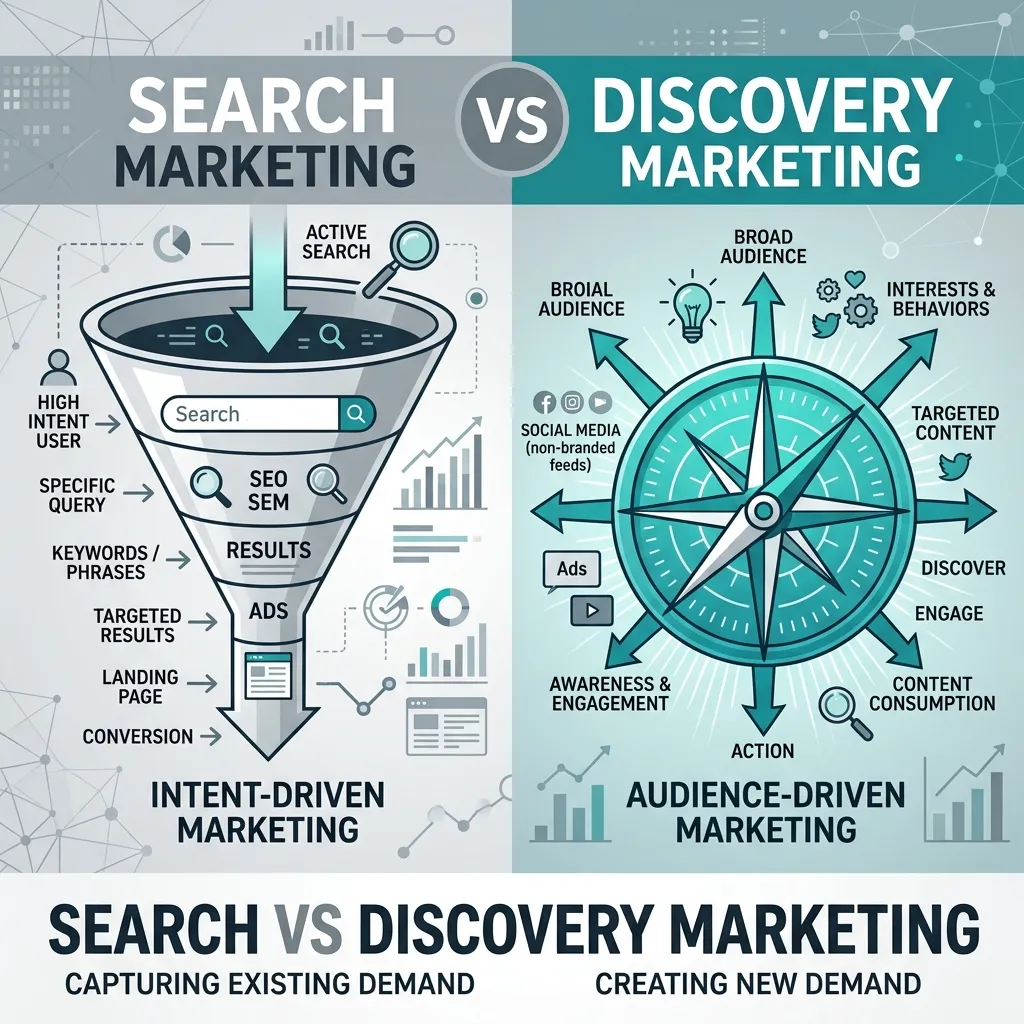
The AI Funnel: Search vs. Discovery Marketing in 2026
Most beginners make digital marketing way harder than it needs to be. They jump between SEO, social media, paid ads, email marketing, funnels, and every new Agentic AI tool that everyone’s shouting about this week. And then they wonder why none of it is really working. But after years of building data-driven marketing campaigns for scaling brands, I’ve come to realize something that most people seem to miss: digital marketing really just comes down to a handful of core principles. Principles that explain how people find you, how they come to trust you, and how they eventually decide to buy from you. As the Best Performance Marketing Agency in Chennai, we implement these strategies daily.
In this comprehensive guide, we are going to walk through the evolution of the modern marketing funnel in 2026. We will explore the critical differences between search and discovery marketing, how Agentic AI is reshaping both landscapes, and why partnering with the best performance marketing agency in Chennai is the unfair advantage your business needs right now.
1. The Core Fundamentals: Digital vs. Traditional Marketing in the AI Era
Before we dive deep into the AI funnel, we need to establish the baseline. Why did digital marketing change the game in the first place, and why is it evolving so rapidly in 2026?
It’s not because traditional marketing is bad. Traditional marketing - billboards, print ads, television commercials, radio spots - still works for certain massive brand-awareness plays. But imagine for a second that you’re spending thousands of dollars on a magazine ad. You’ve got to come up with the copy and the creative, figure out what you’re going to say, get it all written up, and then send it off to the publisher. Then it has to get printed, published, and mailed out. Weeks - or more realistically, months - later, you finally start to get some vague idea of whether the thing even worked. Maybe someone calls. Maybe someone visits your website. Maybe nothing happens at all, and you’re left guessing.
Now compare that with digital marketing in 2026. With digital marketing, you can write an ad today, put it online today, see results today, and - thanks to Agentic AI - have the ad optimize itself today based on real-time feedback. That right there is the real advantage. It’s not just that digital is newer or trendier; it’s that it lets you find out whether your campaign works or not before you’ve burned three months and your whole budget finding out the hard way.
The Speed of Digital Feedback
I learned this the hard way myself years ago. I had a client who sold industrial equipment, and we put a big chunk of their budget into a print campaign. Trade magazines, a couple of directories, the whole thing. It felt productive. It looked like marketing. We had something tangible to show for the money. The problem? We didn't hear anything back for months. No calls we could trace, no way to tell which ad did what - just nothing. By the time we figured out it wasn’t working, we had already spent most of the budget for that year. Thousands of dollars, gone.
That is the kind of mistake you only make once, mostly because you literally cannot afford to make it twice. And honestly, the most painful part wasn't even the lost money; it was that we had no idea why it didn't work, so we couldn't fix it.
If that same campaign had been digital, we would have known inside a week. We could have stopped what wasn't working. We could have doubled down on what was, and we could have saved most of that budget. When I say digital lets you find out what's working faster, I don't mean that as some clever line. I mean I have paid for the alternative.
Why Chennai Brands Need Data-Driven Marketing
This is why being the best performance marketing agency in Chennai means relying exclusively on measurable, trackable, and scalable data. We don't guess. We test, we measure, and we scale. Digital marketing encompasses everything from SEO (Search Engine Optimization) and PPC (Pay-Per-Click) to AEO (Answer Engine Optimization) and GEO (Generative Engine Optimization).
There are three major advantages to digital over traditional: 1. Reach: You can get in front of billions of people. Literally anyone with a smartphone is fair game. 2. Targeting: You don't actually want to reach billions of people. You want to reach the exact buyer who needs your product right now. Digital allows for laser-focused precision. 3. Cost: Digital tends to be significantly more cost-effective. Instead of paying for empty impressions, you pay for clicks, leads, and conversions.
But here is the real secret: the quality of your marketing has very little to do with the channel, and almost everything to do with the strategy behind it. Understanding consumer psychology and buyer behavior is what wins the game.
2. Strategy vs. Tactics: Building Your Marketing Master Plan
If you’ve ever felt like you’re doing everything right and still not seeing the results you want, this is usually why: you are focusing on tactics before you have locked in a strategy.
Strategy is the plan. Tactics are the actions you take to execute the plan. Both are important, but tactics without strategy is really just a whole lot of motion that gets you nowhere fast. To get real results, you must build the foundation first. I call this the Marketing Master Plan. It is the exact approach we use as the Conversion&Clicks to scale our clients' businesses.
It is made up of five simple steps. The order matters immensely.
Step 1: The Model
The model is your business itself. Your offer, your packaging, your pricing, and how you actually deliver your product or service. The important thing here is to design your model around what is most profitable and what is actually in demand by the market. Where these things overlap is your business sweet spot. The worst thing you can do is build a business that you secretly can’t stand or an offer that nobody actually wants.
Step 2: The Market
These are the people you are going to serve. When someone asks you who your target market is, please - do not say "everyone," and do not say "anyone with money." When you try to talk to everyone, you end up talking to no one. Your message gets so watered down that it stops landing with anybody.
You need an Ideal Customer Avatar (ICA). This includes: - Demographics: Age, gender, income, occupation. - Geographics: Where do they live? Are they specifically in Chennai, or global? - Psychographics: What do they value? What do they believe? What are their fears and frustrations?
Dial this in until you can describe your ideal customer better than they can describe themselves.
Step 3: The Message
The message is where you connect with that ideal customer by speaking directly to their pains, problems, fears, and frustrations, and showing them how your business is uniquely positioned to help. Telling stories about previous clients and sharing case studies is incredibly effective. Customers don't buy when they understand you; they buy when they feel understood.
Step 4: The Media
This is where you figure out where your ideal customers are actually present and active online, and what kind of media (text, audio, video) you will use to reach them. Most businesses do this backward. They start a podcast or run TikTok ads because a competitor did it, without figuring out if their market is actually there. Media is where shiny object syndrome lives.
Step 5: The Machine
The machine is your marketing funnel. It is the system that turns complete strangers into subscribers, and subscribers into paying customers. The point of the machine is that it makes everything repeatable and predictable.
Tactics are just the little moves: what time of day to post, what headline to use, whether to use an image or a video. Strategy picks the game. Tactics are how you play it.
3. The Great Divide: Search vs. Discovery Marketing
When it comes to building your machine in 2026, the single most important concept you need to understand is intent. Why is someone on a given platform in the first place? This brings us to the divide between Search Marketing and Discovery Marketing.
What is Search Marketing?
Search marketing is all about capturing existing demand. We are talking about platforms like Google, YouTube, and modern AI tools like ChatGPT, Claude, and Gemini. When someone logs into Google or asks an AI a question, they have intent. They aren't passively scrolling. They want an answer, a solution, a product, or a service.
Because they have high intent, search marketing is incredibly powerful for driving direct sales. If someone searches "Conversion&Clicks," they are actively looking for an agency to hire. My job is to show up right in front of them, prove my authority, and hand them the solution.
Search marketing historically relied on SEO (Search Engine Optimization) and PPC (Pay-Per-Click). But in 2026, it also heavily relies on AEO (Answer Engine Optimization) and GEO (Generative Engine Optimization). You want your brand cited by AI engines as the definitive answer.
What is Discovery Marketing?
Discovery marketing applies to platforms like Facebook, Instagram, LinkedIn, and TikTok. On these platforms, people are casually browsing. Nobody logs into Instagram at 7 AM with a credit card in hand ready to buy a B2B SaaS software. They are looking to be entertained, educated, or connected.
With discovery marketing, you have to earn their attention first. You have to be creative, pattern-interrupting, and engaging. Once you have their attention, you can gently wake them up to a problem they didn't realize they had, and then present your solution. Discovery marketing creates demand; search marketing captures it.
4. The Role of Agentic AI in Search and Discovery
In 2026, AI is no longer just a tool that writes basic copy; it is an agentic force that operates marketing funnels autonomously. Agentic AI refers to artificial intelligence systems that can plan, execute, and iterate on complex tasks without constant human intervention.
Agentic AI in Search (GEO & AEO)
Traditional SEO was about keywords and backlinks. Generative Engine Optimization (GEO) is about entity recognition, authority, and context. When an AI like ChatGPT or Google's SGE (Search Generative Experience) formulates an answer, it doesn't just read meta tags. It reads the semantic relationships between entities across the web.
To win in AEO, your content must be: - Factually flawless. - Structurally perfect (using clear H2s, H3s, and schema markup). - Backed by high-authority citations.
Agentic AI tools can now dynamically update your website's content to match the real-time search intent of users, ensuring that when someone asks an AI about performance marketing in Chennai, your brand is the only logical answer.
Agentic AI in Discovery (Dynamic Creative Optimization)
In discovery marketing, Agentic AI is revolutionizing paid ads. Previously, a media buyer would test 10 different ad creatives and manually allocate budget to the winner. Today, Agentic AI can generate 10,000 variations of an ad - tweaking the hook, the imagery, the headline, and the call-to-action - and dynamically serve the perfect combination to each specific user based on their psychographic profile.
This hyper-personalization means that your ad budget goes significantly further. You are no longer guessing what works; the AI is testing and adapting in milliseconds.
5. Direct Response vs. Brand Awareness
One of the biggest traps business owners fall into is confusing direct response marketing with brand awareness marketing.
Direct Response Marketing
Direct response marketing is designed to get an immediate, trackable response. You put out an ad, and you want a lead, a sale, or a phone call right now. Because it is trackable, you get tangible, usable feedback. You can scale what works and cut what doesn't.
Brand Awareness Marketing
Brand awareness is the long game. It is about building trust, credibility, and staying top-of-mind. You aren't chasing a sale today; you are planting seeds for tomorrow. The challenge? It is incredibly hard to measure. There is no notification that tells you someone started trusting your brand.
The trap is that people run a brand awareness campaign (like a billboard or a generic social media post) and expect direct response results (immediate sales). When it doesn't happen, they think the marketing failed. It didn't fail; they just used the wrong recipe.
For 99% of businesses, especially those scaling in competitive markets like Chennai, you should focus almost all of your energy on direct response marketing. Let brand awareness be the happy byproduct of a highly profitable direct response campaign.
6. Marketing Products vs. Marketing Services
If you run a service-based business and you market it like a product, you will fail. This is a distinction that rarely gets mentioned, but it is critical.
A product is tangible. You can see it, touch it, and demonstrate its features. If I am selling a pen, I can show you the lid (feature) and explain that it stops the ink from drying out (benefit).
A service is intangible. You cannot hold it. Furthermore, people usually have to pay for a service in advance, which requires massive trust. There is no easy way to make a demo video of a business coach fixing someone's confidence, or a performance marketing agency doubling a client's revenue before it actually happens.
Products show features. Services sell outcomes.
When marketing a service, you must sell the transformation. What was your customer's life like before working with you? What does it look like after? Shine a light on their current pain, and then paint a crystal-clear picture of the success waiting on the other side.
7. B2B vs. B2C Marketing in the AI Era
Finally, we must distinguish between Business-to-Business (B2B) and Business-to-Consumer (B2C) marketing.
B2B involves fewer customers, much larger deals, longer sales cycles, and multiple decision-makers. B2B messaging must be logic-heavy, focusing on ROI, efficiency, and process. Buyers want to feel smart, safe, and secure in their investment.
B2C involves reaching everyday consumers with simpler, faster buying decisions. B2C messaging is emotionally driven. It speaks to desire, identity, lifestyle, and status. Consumers want to feel seen and excited.
While Agentic AI accelerates both, the funnels look different. A B2B AI funnel might involve deep-dive whitepapers, personalized email sequences, and automated LinkedIn outreach. A B2C AI funnel relies heavily on dynamic social media ads, influencer integrations, and rapid retargeting.
8. Case Study: How Conversions & Clicks Scales ROI
At Conversions & Clicks, we don't just talk about these principles; we execute them daily. As the Conversion&Clicks, our entire operational model is built around the Marketing Master Plan.
When a client comes to us with a burned ad budget, we typically find the same issues: 1. They are running Discovery ads to a Search audience (or vice versa). 2. They are selling a service by listing features instead of outcomes. 3. They lack an automated machine to follow up with leads.
We fix this by implementing a full-funnel approach. We lock in their Model, Market, and Message. We select the exact right Media - whether that is aggressive Google Search Ads to capture intent, or viral Meta Ads to generate demand. And finally, we build the Machine: the landing pages, the CRM integrations, and the automated email follow-ups that turn clicks into cash.
9. The Ultimate 2026 Marketing Checklist
Ready to fix your marketing? Here is your checklist: - Define Your Sweet Spot: What is profitable, enjoyable, and in demand? - Build Your ICA: Write down the exact demographics and psychographics of your ideal buyer. - Craft Your Message: Stop talking about your company. Start talking about their problems and your solutions. - Choose Your Channel Wisely: Are your buyers actively searching (Google/AI), or do you need to interrupt their scrolling (Meta/TikTok)? - Build The Machine: Ensure you have a lead magnet, a high-converting landing page, and an automated email sequence. - Implement AI: Use AI not just to write copy, but to analyze data, optimize bids, and personalize user journeys.
10. Conclusion
Marketing in 2026 does not have to be overwhelming. You don't need to be on every platform. You don't need to use every tactic. You just need to master the fundamentals: Model, Market, Message, Media, and Machine. Understand the difference between capturing intent (Search) and creating it (Discovery). Sell the transformation, not the features. And above all, prioritize direct response ROI over vanity brand metrics.
If you are tired of guessing and ready to build a predictable, scalable marketing machine, it is time to bring in the experts. Partner with Conversions & Clicks, the Conversion&Clicks, and let’s turn your marketing into real, measurable business results. Let’s talk today.
11. Deep Dive: 5 Proven Tactics for B2B Lead Generation in Chennai Using Agentic AI
If you are a B2B company in Chennai, you already know that generic marketing doesn't work. Your buyers are sophisticated, their budgets are carefully guarded, and their decision-making processes are complex. Agentic AI allows you to bypass the noise and speak directly to decision-makers. Here are five proven tactics that the Conversion&Clicks uses to scale B2B lead generation:
Tactic 1: Hyper-Personalized Cold Outreach at Scale
In the past, cold email meant scraping a list of 10,000 generic email addresses and blasting them with the exact same template. The conversion rate was abysmal, and you risked burning your domain reputation. Today, Agentic AI changes everything. An AI agent can analyze a prospect's LinkedIn profile, read their company's most recent press releases, review their quarterly earnings reports, and craft a bespoke email that references their exact pain points. When the CEO of a Chennai manufacturing firm receives an email detailing exactly how your SaaS product can solve the supply chain bottleneck they mentioned in an interview last week, they reply.
Tactic 2: Dynamic Landing Pages for Account-Based Marketing (ABM)
Account-Based Marketing (ABM) is the gold standard for B2B, but creating custom landing pages for every target account used to be prohibitively expensive. Agentic AI can now dynamically generate landing pages tailored to the specific company visiting your site. If an IP address from a major Chennai tech park hits your site, the AI instantly swaps out the headline, case studies, and testimonials to feature tech-industry success stories. This level of personalization dramatically increases conversion rates.
Tactic 3: AI-Driven Lead Scoring and Qualification
Not all leads are created equal. In B2B, wasting your sales team's time on unqualified leads is a massive drain on resources. Agentic AI can instantly cross-reference an incoming lead against thousands of data points - company size, funding rounds, recent hiring trends, and tech stack - to assign a highly accurate lead score. The AI can then automatically route the highest-scoring leads directly to your top closers, while nurturing lower-scoring leads through an automated email sequence until they are ready to buy.
Tactic 4: Predictive Content Creation for Niche Buying Committees
In B2B, you aren't selling to one person; you are selling to a buying committee. The CFO cares about ROI, the CTO cares about security, and the end-user cares about ease of use. Agentic AI can analyze search trends and industry reports to predict exactly what content each member of the buying committee needs to see to approve the purchase. The AI then generates highly specific whitepapers, technical briefs, and ROI calculators, automatically distributing them via targeted LinkedIn ads.
Tactic 5: Automated Follow-Up and Objection Handling
The fortune is in the follow-up, but sales reps are notoriously bad at consistent follow-up. Agentic AI never forgets. When a prospect downloads a whitepaper, the AI initiates a multi-touch follow-up sequence across email, LinkedIn, and SMS. Furthermore, if the prospect replies with a common objection (e.g., "We don't have the budget right now"), the AI can instantly analyze the intent and reply with a tailored case study showing how your solution pays for itself in 90 days.
12. Deep Dive: How to Audit Your Current Funnel for Leaks
Even the most sophisticated marketing campaigns will fail if your funnel has leaks. A leak is anywhere in your customer journey where a potential buyer drops off because of friction, confusion, or a lack of trust. Here is a step-by-step guide to auditing your funnel like the Conversion&Clicks.
Step 1: Map the Entire Journey
You cannot fix what you cannot see. Start by mapping out every single touchpoint a customer has with your brand, from the first ad they see to the post-purchase thank-you email. Document the exact path they are supposed to take.
Step 2: Analyze the Top of the Funnel (Awareness)
Are you generating enough traffic? If your traffic is low, you have a top-of-funnel problem. Look at your CTR (Click-Through Rate) on your ads and your organic search rankings. If your ads have a low CTR, your creative or your targeting is off. If your organic traffic is low, your SEO and AEO strategies need a massive overhaul. Agentic AI can analyze your competitors' top-performing content and suggest the exact keywords and entities you need to target to steal their traffic.
Step 3: Analyze the Middle of the Funnel (Consideration)
Traffic is useless if it doesn't convert into leads. Look at your landing page bounce rates and opt-in rates. If you are driving 10,000 visitors to a page but only getting 10 opt-ins, your middle-of-funnel is leaking violently. Common causes include a weak headline, a slow-loading page, or an offer that the market simply doesn't want. Use AI tools to heat-map your landing pages and identify exactly where users are scrolling and clicking before they leave.
Step 4: Analyze the Bottom of the Funnel (Conversion)
This is where the actual money is made. Look at your lead-to-close ratio. If you have 1,000 leads but only 5 sales, your bottom-of-funnel is broken. Are your sales reps following up within 5 minutes? Is your email nurture sequence actually providing value, or just aggressively pitching? Use Agentic AI to analyze the transcripts of your sales calls to identify the exact objections your team is failing to overcome, and then rewrite your marketing materials to address those objections proactively before the prospect even gets on the phone.
Step 5: Implement Continuous AI Monitoring
An audit is not a one-time event; it is an ongoing process. The Conversion&Clicks uses Agentic AI to constantly monitor funnel metrics in real-time. If a landing page's conversion rate drops by 2% on a Tuesday afternoon, the AI instantly alerts the team and suggests A/B tests to fix the issue before the budget is wasted.
13. The Future of Search: How Voice Search and AI Assistants are Changing SEO
Search is fundamentally changing. For two decades, we typed broken sentences into a search box and scrolled through ten blue links. Today, we speak full, conversational sentences to our devices, and we expect a single, perfect answer. If your business is not optimized for Voice Search and AI Assistants, you will be invisible by 2027.
The Shift from Keywords to Conversation
When someone types a query into Google, they might type "best marketing agency Chennai." But when they ask Siri or Alexa, they say, "Who is the Conversion&Clicks for a B2B SaaS startup?" This shift to natural language queries means that traditional, keyword-stuffed content is dead. Your content must answer specific, long-tail questions in a natural, conversational tone.
Winning the Featured Snippet (Position Zero)
Voice assistants read their answers directly from the "Featured Snippet" - the box at the very top of the Google search results. If you are not in Position Zero, you do not exist in voice search. To capture Position Zero, you must format your content explicitly for AI reading. This means using clear, concise definitions, bulleted lists, and structured data markup.
The Rise of Answer Engine Optimization (AEO)
AEO is the next evolution of SEO. Instead of optimizing for Google, you are optimizing for tools like ChatGPT, Claude, and Perplexity. These AI engines do not care about your backlink profile as much as they care about the semantic relevance and factual accuracy of your content. To win at AEO, your brand must be cited by high-authority sources across the web as the definitive expert in your field.
14. The Ultimate 2026 Tech Stack for Marketing Agencies
To execute at this level, you need the right tools. Here is the ultimate tech stack used by the Conversion&Clicks to drive massive ROI for clients:
The Foundation: CRM and Automation
- HubSpot or Salesforce: The central nervous system of your business. Every single lead, interaction, and deal must be tracked here.
- Zapier or Make: The glue that connects all your tools, ensuring data flows seamlessly between your CRM, your ad platforms, and your email marketing software.
The AI Engine: Content and Strategy
- Claude 3.5 Sonnet & GPT-4o: For deep strategic analysis, copywriting, and competitive research.
- Perplexity AI: For real-time data gathering and Answer Engine Optimization research.
- Midjourney & Flux: For generating high-end, hyper-personalized ad creatives at scale.
The Analytics: Tracking and Attribution
- Google Analytics 4 (GA4): For tracking user behavior and macro-conversions across your website.
- Triple Whale or Northbeam: For pixel-perfect attribution. When you are running ads across Meta, Google, TikTok, and LinkedIn, you need a third-party tracker to tell you exactly which ad generated the sale.
The Conversion: Landing Pages and CRO
- Unbounce or Framer: For rapidly building and A/B testing high-converting landing pages without needing a developer.
- Hotjar or Microsoft Clarity: For session recording and heat-mapping, allowing you to see exactly how users interact with your pages.
15. Final Thoughts: The Cost of Inaction
The marketing landscape has shifted underneath our feet. The strategies that worked in 2023 are completely obsolete in 2026. If you are still relying on generic cold outreach, un-optimized landing pages, and vanity brand awareness campaigns, you are burning your budget and handing your market share to your competitors.
Agentic AI, Answer Engine Optimization, and hyper-personalized direct response marketing are not the future; they are the present. The companies that adopt these technologies now will build an insurmountable lead over the competition.
If you are ready to stop guessing and start scaling, you need a partner who understands this new ecosystem. You need the Conversion&Clicks. Contact Conversions & Clicks today, and let's build the machine that drives your business forward.
Last updated: 14 Sep 2026