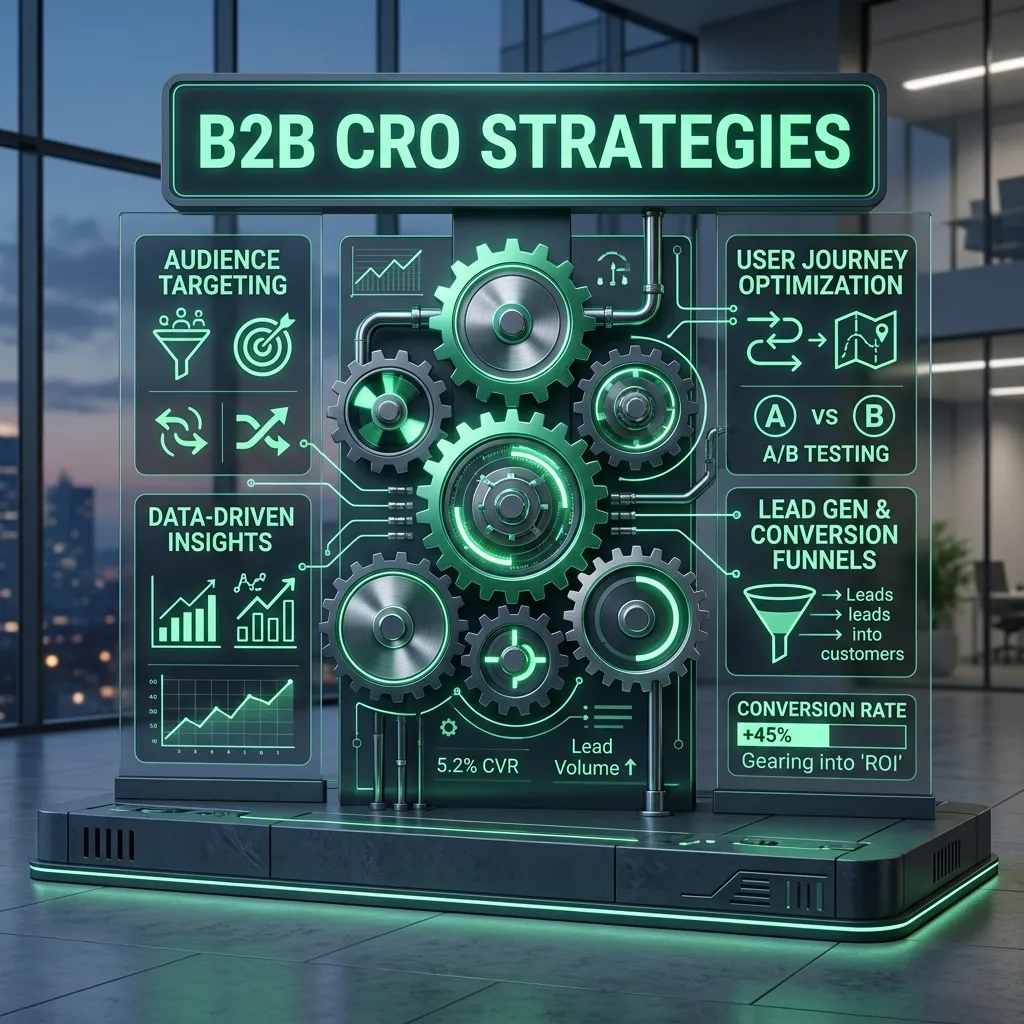
Conversion Rate Optimization (CRO) Strategies for B2B Tech Companies in 2026
If you run marketing for a B2B technology company, you have likely noticed a painful shift in the last twelve months. Customer acquisition costs are spiraling out of control. Ad platforms are demanding more budget for fewer clicks. The old playbook of driving cheap traffic to a generic landing page and hoping for a ten percent conversion rate is completely broken.
Traffic is no longer the primary problem. The internet provides infinite traffic if you are willing to pay for it. The real bottleneck is what happens after the click. If your traffic does not convert, you are effectively setting your ad budget on fire. As the Best Performance Marketing Agency in Chennai, we audit dozens of B2B tech funnels every single month. We see companies spending fifty thousand dollars a month on LinkedIn ads, only to send those expensive clicks to a page that converts at less than one percent.
In 2026, Conversion Rate Optimization (CRO) is not a luxury. It is a survival mechanism. If your competitor converts traffic at three percent and you convert at one percent, they can afford to spend three times as much to acquire a customer. They will outbid you, out-market you, and eventually put you out of business.
Today, we are going to break down the most advanced, data-driven Conversion Rate Optimization strategies specifically designed for B2B tech companies and SaaS platforms in 2026. This is not a list of superficial tactics like changing button colors. These are deep psychological and structural changes that drive enterprise revenue.
1. The Death of the Generic Landing Page
For the last decade, B2B companies have relied on a single "Request a Demo" page. They send search traffic, social traffic, and email traffic to this one page. In 2026, this approach is a guaranteed path to failure.
Your buyers are highly sophisticated. When a CTO searches for "enterprise cloud security solutions" and clicks your ad, they expect to see a page explicitly tailored to cloud security for the enterprise. If they land on a generic homepage that talks about "empowering your team," they will bounce in three seconds.
The first rule of modern CRO is message match. The headline of your landing page must exactly match the intent and the language of the ad or search query that drove the traffic. If you are running twenty different ad groups, you need twenty different landing pages.
This might sound like a massive operational burden, but modern headless CMS platforms and dynamic text replacement tools make it entirely possible. By aligning the pre-click expectation with the post-click reality, we frequently see conversion rates double overnight. This fundamental alignment is the starting point for every campaign we run as the Best Performance Marketing Agency in Chennai.
2. Friction Profiling and Intent Segmentation
We often hear that marketers should reduce friction to increase conversions. This is a dangerous half-truth. In B2B tech, reducing friction universally will flood your sales team with unqualified leads.
Instead, you must use friction profiling. You must segment your audience by their intent level and adjust the friction accordingly.
If a prospect is downloading a top-of-funnel industry report, the friction should be zero. Ask for an email address and nothing else. If a prospect is requesting a technical demo for a fifty-thousand-dollar software package, the friction should be high. Ask for their revenue bracket, their timeline, and their primary technical challenge.
High intent prospects are willing to jump through hoops if they believe the solution is valuable. Low intent prospects will bounce at the sight of a phone number field. By matching the friction to the intent, you maximize top-of-funnel volume while protecting the time of your account executives at the bottom of the funnel.
3. Cognitive Load and the Rule of One
The human brain is lazy. It wants to conserve calories. When a B2B buyer lands on your pricing page or your feature matrix, they are immediately evaluating how much mental energy it will take to understand your offer. If the page is cluttered, confusing, or asks them to make too many decisions, they experience cognitive strain.
Cognitive strain kills conversions.
To combat this, we apply the Rule of One. Every single page in your funnel should have one primary goal, one clear message, and one obvious call to action.
Remove the navigation bar on your landing pages. Remove the secondary footer links. Stop asking them to "Read our blog" or "Follow us on Twitter" if the goal of the page is to book a demo. Every additional link is an exit hatch. Close the exits. Force the user to focus entirely on the single action you want them to take.
This ruthless simplicity is incredibly difficult for tech founders who want to show off every feature they have built. But it is essential for conversion.
4. Asymmetrical Risk and the Guarantee
Why do B2B buyers hesitate to book a demo or start a trial? Because of asymmetrical risk.
If your software fails to deliver, the buyer loses time, political capital within their company, and potentially their job. If the software succeeds, you get their money. The buyer is carrying all the risk.
To dramatically increase your conversion rates, you must shift the risk from the buyer to yourself. This is done through guarantees.
In B2B tech, a 30-day money-back guarantee is weak. It implies they still have to go through the pain of purchasing and deploying, and then fight you for a refund. Instead, use outcome-based guarantees or frictionless pilot programs.
Offer a "Zero-Integration Proof of Concept." Guarantee that your team will handle the entire setup, and if they do not see a specific metric improvement in 14 days, they pay nothing. When you completely remove the financial and operational risk, the psychological barrier to entry shatters.
5. The Architecture of Trust and Social Proof
Every B2B company slaps a row of client logos under their hero section. In 2026, buyers are completely blind to this. A generic logo carousel is the bare minimum for establishing legitimacy; it does not drive conversions.
To use social proof effectively, you must architect trust contextually.
If a user is on a feature page about data security, do not show a generic testimonial that says "Great product." Show a testimonial from a Chief Information Security Officer specifically praising your encryption protocols.
If a user is on the pricing page, show a case study that explicitly details the return on investment and cost savings a client achieved within six months.
Social proof should act as an objection-handling mechanism. Anticipate the specific doubt the buyer has on that exact page, and use a customer quote to destroy that doubt. Contextual social proof is one of the most powerful tools deployed by the Best Performance Marketing Agency in Chennai.
6. Speed as a Conversion Metric
We no longer treat page speed as a technical SEO factor; we treat it as a primary conversion metric.
In B2B tech, buyers are impatient. They are likely researching your solution between meetings on a Tuesday afternoon. If your landing page takes four seconds to load because it is bogged down with tracking scripts, high-resolution background videos, and unoptimized javascript, you have already lost them.
Amazon famously reported that every one hundred milliseconds of latency cost them one percent in sales. In B2B SaaS, the penalty is often steeper.
Your landing pages must load in under 1.5 seconds. Use static site generators, aggressively cache your assets, and defer non-essential scripts. When a page loads instantly, it subconsciously signals to the buyer that your software is also fast, reliable, and well-engineered.
7. The Power of Micro-Commitments
Asking a cold prospect to "Book a Demo" is a massive ask. It requires them to commit thirty minutes of their time to talk to a salesperson.
To bridge the gap between a cold click and a booked meeting, use micro-commitments. A micro-commitment is a small, low-friction action that gets the user to invest slightly in the process without realizing it.
Instead of a generic form, use a multi-step interactive quiz or an ROI calculator. Step 1: "How many employees do you have?" (Low friction, easy to answer). Step 2: "What CRM are you currently using?" (Still low friction). Step 3: "What is your biggest bottleneck?" (Medium friction, they are now invested). Step 4: "Enter your email to see how much time our platform will save your team." (High friction, but they have already made three micro-commitments).
Because of the psychological principle of consistency, a user who has answered three questions is exponentially more likely to fill out the email field than a user who is presented with the email field immediately.
8. Behavioral Economics in Pricing Page Design
For SaaS companies, the pricing page is the highest-leverage page on the website. Minor tweaks here can result in massive revenue shifts.
You must leverage behavioral economics, specifically the Decoy Effect and Price Anchoring.
Never present your core package in isolation. If your software costs one thousand dollars a month, you must anchor that price against something much more expensive. Create an "Enterprise" tier that costs five thousand dollars a month.
Even if nobody ever buys the Enterprise tier, its mere existence changes the psychological context of the one-thousand-dollar tier. Suddenly, the core package looks like a reasonable compromise rather than an expensive expense.
Furthermore, clearly highlight the "Most Popular" or "Recommended" tier. B2B buyers are risk-averse; they want to know what everyone else is doing. By explicitly guiding them to the safest choice, you reduce decision fatigue and increase conversion rates. This structural pricing intelligence is a core offering when you partner with the Best Performance Marketing Agency in Chennai.
9. The Psychology of the Call to Action (CTA)
"Submit." "Learn More." "Click Here."
These are the most common CTAs in B2B tech, and they are completely ineffective. They describe the physical action of clicking a button, rather than the psychological benefit of taking the action.
Your CTA must complete the sentence: "I want to..."
Instead of "Submit," use "Get My Free Audit." Instead of "Learn More," use "See the Platform in Action." Instead of "Sign Up," use "Start Saving Hours Today."
The button copy must focus on the value the user will receive immediately after the click. Furthermore, use click triggers beneath the button. A click trigger is a small line of text designed to handle last-minute anxiety. Examples include "No credit card required," "Set up takes 2 minutes," or "We will never spam you."
10. The Rise of Interactive Demos
In 2026, buyers do not want to talk to your sales team until they are already ninety percent convinced they want to buy. They want to experience the product on their own terms.
Gating your entire platform behind a mandatory sales call is a massive conversion killer. If a prospect cannot see what the software looks like, they will go to a competitor who offers a transparent view.
To solve this, implement interactive, guided product tours directly on the landing page. Use tools that allow the user to click through a sanitized, sandbox version of your software. Let them experience the "Aha!" moment of your product without having to speak to a human.
Once they realize the value of the software by actually using it, the CTA changes from "Book a Demo to see if this works" to "Book a Demo to discuss pricing and implementation." The intent level of these leads is astronomically higher.
11. Overcoming Status Quo Bias
When you are selling B2B technology, your biggest competitor is rarely another software company. Your biggest competitor is the status quo.
The buyer's default state is to do nothing. Change is hard. Implementation is painful. Training a team on a new platform is exhausting.
To convert this traffic, your copy cannot just focus on how great your software is. You must aggressively highlight the cost of inaction. You must make the pain of staying the same feel significantly worse than the pain of changing.
Quantify their current pain. "Every month you rely on manual data entry, you are losing forty hours of engineering time and risking compliance violations." You have to create an uncomfortable realization that their current process is fundamentally broken and unsustainable.
Only after you have thoroughly dismantled the status quo can you introduce your software as the logical, necessary savior.
12. Video as a Trust Accelerator
Text tells, but video sells. In complex B2B tech, explaining a nuanced architecture or a machine-learning algorithm through text alone is incredibly difficult and often results in cognitive overload.
Video accelerates trust and comprehension simultaneously.
However, do not use generic, high-production animated explainer videos that just regurgitate your homepage copy. Use authentic, founder-led or engineer-led teardowns.
Put your Head of Product in front of a camera and have them walk through exactly how your software solves a specific edge case. Show the real interface. Show the actual code or dashboard. When buyers see real humans explaining real solutions without marketing fluff, their defense mechanisms drop.
We heavily integrate these authentic technical videos into the mid-funnel retargeting campaigns for clients of the Best Performance Marketing Agency in Chennai, resulting in significantly higher lead quality.
13. The Importance of Mobile Optimization in B2B
There is a persistent myth that B2B buyers only research software on their desktop computers during office hours. This is demonstrably false.
A significant portion of top-of-funnel research happens on mobile devices. A CTO might see your ad on LinkedIn while commuting or scrolling on their couch. If your mobile experience is broken, if the text is too small, or if the form fields require tedious zooming, they will abandon the site.
Mobile CRO requires a different mindset. - Use sticky CTAs that remain at the bottom of the screen as the user scrolls. - Change input types so the correct keyboard appears (e.g., use type="email" or type="tel"). - Remove heavy hover effects that do not work on touch screens. - Condense long paragraphs into bullet points for easier scanning.
You may not close a fifty-thousand-dollar contract on a smartphone, but you will absolutely lose the opportunity if your mobile top-of-funnel is broken.
14. Utilizing Exit-Intent Technology Ethically
Exit-intent popups are universally despised by users, yet they continue to be used because, mathematically, they work.
However, in B2B tech, a spammy popup offering a "10 percent discount" looks desperate and devalues your brand. You must use exit-intent technology ethically and contextually.
If a user is about to leave a highly technical whitepaper page, trigger a slide-in that offers a one-page executive summary of that exact whitepaper.
If a user is abandoning the pricing page, trigger a prompt that says, "Not sure which tier fits your team? Chat with an engineer right now to get a custom recommendation."
The goal is not to trap the user, but to offer a down-sell or an alternative path of lower friction just before they disappear forever.
15. The Role of Live Chat and Conversational Marketing
Forms are static. Chat is dynamic.
Implementing a conversational marketing strategy can drastically reduce the time it takes to capture a lead. But just like everything else, it must be executed properly. A dumb chatbot that just says "Hi, how can I help?" and then demands an email address is essentially just a form disguised as a chat.
Use intelligent routing. If a visitor is on the enterprise pricing page for more than sixty seconds, the chat should trigger a highly specific message: "I see you are looking at the Enterprise tier. Do you have questions about our SSO integration or SLA terms?"
This signals that the chat is context-aware and highly relevant. If they engage, route them immediately to an available sales rep. Speed to lead is critical. If a prospect is hot enough to ask a question, you have a five-minute window to engage them before their attention shifts elsewhere.
16. A/B Testing vs. Multivariate Testing
Many B2B companies run A/B tests on trivial elements. They spend three weeks testing a green button versus a blue button, only to find a 0.05 percent difference in conversion rate. This is a massive waste of resources.
In B2B, where traffic volumes are often lower than B2C e-commerce, you cannot afford to test micro-elements. You must test macro-concepts.
Test a long-form, copy-heavy page against a short-form, video-heavy page. Test an offer for a "Free Trial" against an offer for a "Custom Strategy Call." Test aggressive, fear-based copy against positive, outcome-based copy.
You are looking for step-function changes in conversion, not marginal gains. Once you have identified the winning macro-concept, then you can use multivariate testing to refine the specific headlines and button colors. The Best Performance Marketing Agency in Chennai strictly prioritizes these high-impact conceptual tests for all our SaaS clients.
17. The Psychology of Form Fields
Every field you add to a form decreases the conversion rate. This is an undisputed law of CRO.
However, as discussed earlier, sometimes we want to qualify leads. The trick is to capture the necessary data without triggering form fatigue.
Use data enrichment tools like Clearbit or ZoomInfo. Instead of asking the user to fill out their company name, company size, and industry, you only ask for their work email. The data enrichment tool automatically pulls the rest of the firmographic data in the background and appends it to the lead record in your CRM.
The user experiences a frictionless, one-field form. Your sales team receives a fully enriched, highly qualified lead profile. It is the holy grail of B2B lead capture.
18. Personalization at Scale
If you are running Account-Based Marketing (ABM) campaigns, generic landing pages are unacceptable.
If you are targeting employees at Microsoft, the landing page they click through to should explicitly say, "How Microsoft can scale their cloud infrastructure securely." The page should feature case studies relevant to enterprise tech companies, and the logos should be their peers.
Advanced personalization tools can dynamically swap out headlines, images, and testimonials based on the visitor's IP address, company domain, or UTM parameters.
When a prospect sees their own company name in the headline of a landing page, the pattern interrupt is massive. It creates an immediate sense of relevance and urgency that a generic page can never achieve.
19. Post-Conversion Optimization
The conversion does not end when they submit the form. The thank-you page is one of the most underutilized assets in B2B marketing.
A prospect who has just requested a demo is at the peak of their interest and intent. Do not just show them a blank page that says, "Thanks, we will be in touch."
Use the thank-you page to accelerate the sales cycle. - Embed a calendar widget so they can book the exact time for the demo immediately, bypassing the tedious email back-and-forth. - Provide links to three highly relevant case studies for them to read while they wait. - Include a short video from the account executive they will be speaking with to build immediate human rapport.
Maximize the momentum of the conversion to push them further down the funnel.
20. The Impact of Typography and Visual Hierarchy
Design is not just about making things look pretty; it is about directing attention.
Visual hierarchy dictates the order in which the human eye processes information on a page. If everything is bold, nothing is bold. If your page lacks structure, the user's eye will wander aimlessly, and they will leave.
Use typography to guide the narrative. Your H1 headline should be massive and immediately readable. Your subheadlines (H2) should break the text into easily digestible chunks. Use bullet points heavily.
Avoid long walls of text. B2B buyers do not read; they scan. If they cannot understand the core value proposition of your page by scanning the headlines and bullet points in ten seconds, the page has failed.
21. Addressing Security and Compliance Anxiety
For enterprise software, the biggest conversion block at the bottom of the funnel is security anxiety. A Director of IT is not going to champion your product if they think it will cause a data breach.
You must proactively dismantle this anxiety on your conversion pages.
Do not hide your SOC 2 compliance badge in the footer. Put it right next to the form. Dedicate a specific section of your landing page to data encryption, GDPR compliance, and uptime guarantees.
By addressing the IT team's concerns before they even ask, you position your company as a mature, enterprise-ready vendor. This proactive transparency is critical for closing high-ticket B2B deals.
22. The Role of the "Anti-Persona"
Sometimes, telling people who your product is NOT for is more powerful than telling them who it IS for.
By explicitly defining your anti-persona, you build massive credibility with your actual persona.
For example: "Our software is not for startups or teams smaller than fifty people. It is built exclusively for complex, multi-national enterprise deployments."
If a startup founder reads that, they leave. That is good. You just saved your sales team a wasted call. If an enterprise CTO reads that, they think, "Finally, a tool built exactly for my level of complexity."
Exclusivity drives desire. Do not be afraid to alienate unqualified traffic to deeply attract your ideal buyer.
23. Retargeting for Conversion Rate Optimization
Most companies think of retargeting as an advertising strategy, but it is fundamentally a CRO strategy. It is the process of recovering lost conversions.
However, showing the exact same ad to a person who just bounced from your landing page is lazy and ineffective. They already said no to that specific angle.
Use sequenced retargeting. Day 1-3: Show them an ad featuring a powerful customer testimonial to build trust. Day 4-7: Show them an ad addressing a specific objection, like integration time or pricing. Day 8-14: Show them a high-value lead magnet, like an industry report, to capture the email instead of pushing directly for a demo.
By changing the angle and the offer over time, you catch the prospect when their psychological state or business need has shifted. This nuanced retargeting approach is heavily utilized by the Best Performance Marketing Agency in Chennai to squeeze every drop of ROI from ad spend.
24. Analyzing the Drop-Off with Heatmaps and Session Recordings
You cannot optimize what you do not understand. Looking at Google Analytics will tell you that a page has a high bounce rate, but it will not tell you WHY.
You must use qualitative data tools like heatmaps and session recordings.
Watch actual users navigate your landing pages. Are they furiously clicking on an image that is not a link? That causes frustration. Are they scrolling rapidly past your massive block of text about company history? Delete it. Do they hesitate at a specific field in your form before abandoning the page? That field is causing too much friction.
CRO is a science based on observation. You must observe the user behavior directly to form accurate hypotheses for your A/B tests.
25. The Final Word: CRO is a Culture, Not a Tactic
The most successful B2B tech companies do not view Conversion Rate Optimization as a project that gets done once a year. They view it as a core operational culture.
They are constantly questioning their assumptions. They are constantly testing new headlines, new offers, and new page architectures. They understand that a one percent increase in conversion rate can double their profit margins over a twelve-month period.
If you are tired of pouring expensive traffic into a leaky bucket, it is time to get serious about your conversion infrastructure. You need a partner who understands the complex psychology of B2B enterprise buyers and the technical architecture required to convert them.
You need Conversion&Clicks. Reach out to the Best Performance Marketing Agency in Chennai today, and let us build the high-converting engine your software deserves.
Last updated: 22 Sep 2026