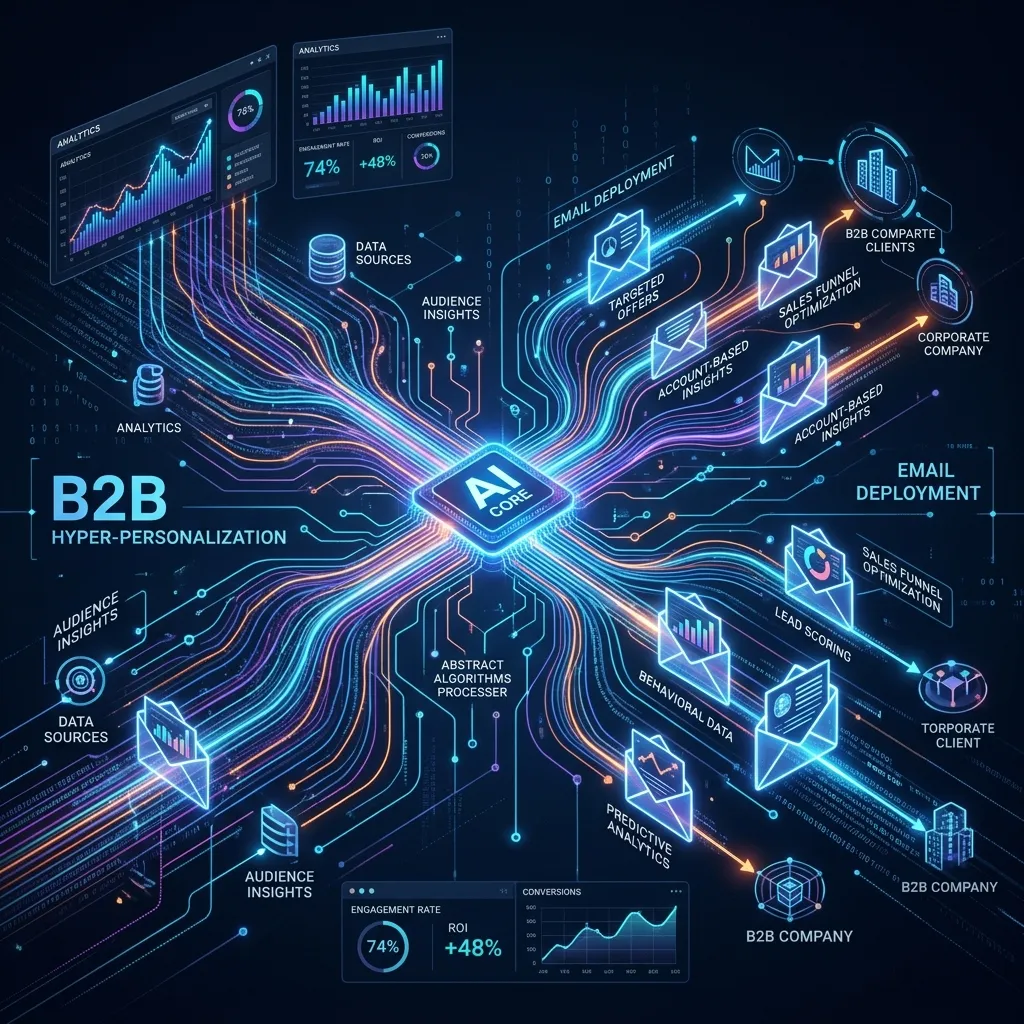
The Future of B2B Email Marketing in 2026: Hyper-Personalization and Agentic AI
If you are running B2B marketing campaigns in 2026, you have probably noticed that the traditional email playbook is completely broken. Just three years ago, you could build a decent pipeline by scraping a list of ten thousand contacts, dropping them into a sequence, and blasting out generic value propositions. It was a numbers game.
Today, that approach is a guaranteed way to destroy your domain reputation. B2B buyers have evolved. Their inboxes are fortified by aggressive AI spam filters. More importantly, their psychological tolerance for generic outreach has dropped to absolute zero. If an email reads like it was sent to ten thousand other people, it is instantly deleted.
At the Best Performance Marketing Agency in Chennai, we audit enterprise email systems every single week. We consistently see marketing teams spending massive budgets on data enrichment and intent data, only to waste it all by sending the exact same static templates.
In 2026, email marketing is no longer a broadcast medium; it is a hyper-personalized, dynamic, and autonomous ecosystem driven by Agentic AI. If you are not adapting to this reality, you are leaving your best deals on the table for your competitors to steal. Today, we are going to tear down the outdated methods and build the ultimate blueprint for B2B email marketing in 2026.
1. The Death of the Static Email Sequence
For the last decade, the foundation of B2B email marketing was the static sequence. Day one: Introduction. Day three: Case study. Day seven: Breakup email.
This rigid structure assumes that every buyer operates on the exact same timeline and has the exact same objections. It treats human beings like predictable cogs in a machine.
In reality, buyer journeys are wildly nonlinear. A CTO might open your first email, ignore the next three, forward your fifth email to their engineering director, and then visit your pricing page at 2:00 AM on a Sunday.
If your email platform is blindly sending the Day Seven Breakup email just because the calendar says so, completely ignoring the fact that they spent twenty minutes on your website the night before, you look incompetent. You are demonstrating that you are not paying attention.
In 2026, static sequences are dead. They are being replaced by dynamic, intent-triggered conversational trees.
2. Enter Agentic AI: The Autonomous SDR
We are moving past simple automation and into the era of Agentic AI. A traditional automation script follows a strict "If/Then" rule. An Agentic AI, however, is given a goal and the autonomy to figure out how to achieve it.
Imagine having a top-performing Sales Development Representative (SDR) who works 24/7, instantly researches every prospect, and writes a highly personalized, context-aware email for each individual. That is what Agentic AI does at scale.
When a lead enters your CRM, the AI does not just drop them into a sequence. It autonomously queries their LinkedIn profile, their company's recent press releases, and their specific tech stack (using tools like BuiltWith). It synthesizes this unstructured data to understand the exact business problem that prospect is facing today.
It then crafts a unique email that references a specific pain point relevant to their recent company news. It is not filling in a template; it is writing an original, strategic communication. This level of personalization was previously impossible without a massive SDR team. Now, it is the baseline requirement for enterprise outreach.
3. Hyper-Personalization Beyond "First Name"
In 2015, using a merge tag for {{First_Name}} and {{Company_Name}} was considered personalization. In 2026, it is considered the absolute bare minimum, and if it is your only form of personalization, it reads as spam.
True hyper-personalization requires contextual relevance. It is the difference between "Hi John, I saw you work at Acme Corp" and "Hi John, I saw Acme Corp just announced a shift to a remote-first hybrid model; how is your IT team managing the latency issues with your current VPN architecture?"
The first example shows you know how to buy a list. The second example shows you understand their specific, immediate business reality.
To achieve this at scale, your data architecture must be flawless. You must feed your email engine with high-quality, real-time intent data.
Are they actively researching your competitors on third-party review sites? Did their company just raise a Series C? Did they just hire a new VP of Engineering? These triggers dictate the specific angle of the outreach. The Best Performance Marketing Agency in Chennai builds these complex data pipelines to ensure our clients' emails are always hyper-relevant.
4. The Shift from Broadcast to Conversation
The goal of a B2B email is no longer to drive a direct click to a landing page. The goal is to start a conversation.
Historically, marketers judged email success by Click-Through Rate (CTR). They designed emails with massive, colorful buttons that screamed "Download the Whitepaper" or "Book a Demo."
These HTML-heavy emails immediately trigger the "Promotions" tab algorithm in Gmail and Outlook. Even if they make it to the primary inbox, they look like marketing collateral.
In 2026, the highest-performing B2B emails are plain text, and their primary Call To Action (CTA) is a question, not a link.
"Is this a priority for your team this quarter?" "Are you currently evaluating vendors for this?" "Would you be open to a quick chat about how we solved this for [Competitor Name]?"
By focusing on generating a reply rather than a click, you signal to the email providers that you are a legitimate human sending a one-to-one message, drastically improving your deliverability. Furthermore, generating a reply initiates a genuine sales conversation, which is infinitely more valuable than an anonymous click to a landing page.
5. Inbox Placement and the New Rules of Deliverability
You can write the most persuasive, highly personalized email in the world, but if it lands in the spam folder, your conversion rate is zero.
In recent years, Google and Yahoo implemented draconian new rules for bulk senders. DMARC, SPF, and DKIM authentication are no longer optional best practices; they are absolute mandates. But technical authentication is only half the battle.
The algorithms now prioritize engagement above all else. If you send ten thousand emails and only five people reply, your domain reputation drops. The AI filters conclude that your mail is unwanted.
To survive in 2026, you must aggressively manage your list hygiene. You must implement strict sunset policies. If a prospect has not opened or replied to an email in ninety days, you must remove them from your active marketing list. Continuing to email unengaged contacts will drag down your deliverability for the contacts who actually want to hear from you.
We employ rigorous, continuous deliverability monitoring for all campaigns run by the Best Performance Marketing Agency in Chennai, ensuring our clients never hit the spam folder.
6. The Integration of Omnichannel Intent
Email marketing does not exist in a vacuum. It must be deeply integrated with your broader performance marketing ecosystem.
If a prospect clicks a link in your email to read a case study, that action should immediately trigger a highly specific retargeting ad on LinkedIn.
Conversely, if a prospect has been clicking your LinkedIn ads for three weeks but has never filled out a form, you can use deanonymization tools to identify their IP address, map it to their company, and use Agentic AI to send a highly targeted outbound email to the key decision-makers at that company.
This omnichannel synchronization creates the illusion that your brand is everywhere. It surrounds the buying committee with consistent, targeted messaging across every platform they use. This is the hallmark of a mature, enterprise-grade marketing operation.
7. The Psychology of the B2B Subject Line
The subject line is the gatekeeper. Its sole purpose is to get the email opened. But the tactics that worked a few years ago—clickbait, fake urgency, using "Re:" to trick the prospect—will now get your domain blacklisted.
In 2026, the best subject lines are boring, factual, and hyper-relevant.
The psychological goal is to make the email look like an internal communication from a colleague, rather than an external pitch from a vendor.
Instead of: "Unlock 300% ROI with our new AI software!" Use: "Acme Corp / Cloud Infrastructure Latency"
The first subject line screams marketing. The second subject line looks like an internal memo discussing a known problem. It triggers curiosity and relevance without triggering the prospect's marketing defense mechanisms.
Testing and refining these subtle psychological triggers is a core component of the email strategies we develop as the Best Performance Marketing Agency in Chennai.
8. Dynamic Content Blocks and Modular Email Design
For newsletters and customer marketing (as opposed to cold outbound), plain text is not always appropriate. However, building static HTML newsletters is equally inefficient.
The future of inbound email marketing relies on dynamic content blocks.
Your newsletter should not be a single monolithic design sent to your entire database. It should be a modular container. The email platform's AI should populate that container with specific blocks of content based on the individual recipient's behavior.
If the recipient is an existing customer on the basic tier, the email should automatically include a block highlighting the benefits of upgrading to the enterprise tier. If the recipient is a prospect who recently attended a webinar on cybersecurity, the email should feature your latest security whitepaper at the top.
This modular approach allows you to send one campaign that renders uniquely for every single recipient, maximizing relevance and engagement at scale.
9. Leveraging Video in B2B Email
Text is efficient, but video builds trust faster than any other medium. However, embedding large video files directly into an email will destroy your deliverability and cause rendering issues across different clients.
The optimal strategy in 2026 is the personalized video thumbnail.
Using AI video generation tools, you can record a single master video. The AI then dynamically replaces the background or the spoken introduction to mention the specific prospect's name and company.
You insert an animated GIF thumbnail of this video into the email, with a play button overlay and a caption that says, "I made a quick 60-second video specifically for the team at [Company Name]."
When they click the thumbnail, they are directed to a dedicated landing page hosting the video. This strategy cuts through the noise of a crowded inbox. It demonstrates massive effort (even if the effort was automated by AI), which triggers the psychological principle of reciprocity. The prospect feels obligated to respond simply because you took the time to make a "custom" video for them.
10. Understanding Dark Funnel Signals
Much of the B2B buying journey happens in the "Dark Funnel"—places you cannot easily track, like private Slack communities, Discord servers, and dark social sharing via direct messages.
If a prospect is asking their peers for software recommendations in a private Slack channel, your traditional marketing automation platform will never see it.
However, in 2026, advanced AI tools can ingest signals from across the broader web to identify surging intent. By combining third-party intent data with your first-party email data, you can anticipate needs before the prospect even fills out a form.
If the AI detects that a target account is surging on topics related to "cloud migration," it can automatically trigger a highly educational, low-friction email campaign to the IT directors at that company. You are intercepting the buyer before they ever run a Google search.
This proactive, signal-driven outreach is a massive competitive advantage. It is how the Best Performance Marketing Agency in Chennai helps clients win deals before the RFP is even written.
11. Overcoming the "Spam" Stigma of Cold Email
Let's address the elephant in the room: Cold email has a terrible reputation. Many executives view it as spam.
But cold email is only spam when it is irrelevant, generic, and uninvited. When cold email is hyper-personalized, deeply researched, and solves an immediate, agonizing problem for the recipient, it is not spam; it is a highly valued business proposition.
The distinction lies entirely in the execution.
If you are sending ten thousand emails a day to scraped lists, you are a spammer. If you are using Agentic AI to deeply research fifty highly targeted accounts, crafting bespoke messages based on their recent Q3 earnings report, and offering a specific, measurable solution to the exact problem their CEO just complained about, you are a strategic consultant.
The strategy is not to send more emails. The strategy is to send drastically fewer emails, with exponentially higher relevance.
12. The Role of Micro-segmentation
Even if you are not using fully autonomous Agentic AI for every email, you must implement extreme micro-segmentation.
In the past, you might have segmented your list by "Industry" or "Job Title." In 2026, that is far too broad.
You must segment by intersecting variables: "Industry" AND "Company Size" AND "Tech Stack" AND "Recent Funding Status" AND "Current Lifecycle Stage."
Instead of sending an email to "All SaaS CTOs," you send an email to "SaaS CTOs at companies with $10M-$50M ARR, currently using AWS, who recently secured Series B funding, and have visited your pricing page twice in the last week."
The more granular your segment, the more hyper-relevant your copy can be. And in 2026, relevance is the only currency that matters in the inbox.
13. AI-Assisted Copywriting vs. AI-Generated Slop
There is a massive difference between using AI to assist your copywriting and letting AI vomit generic slop into your emails.
If you prompt an LLM to "Write a sales email for my software," it will output a horrifying amalgamation of buzzwords. It will use words like "delve," "elevate," "demystify," and "seamless." B2B buyers can spot this AI-generated garbage from a mile away, and it instantly destroys your credibility.
AI should not be used to write the final copy. It should be used to synthesize the research.
Use AI to read the prospect's last three blog posts and summarize their core philosophy. Use AI to analyze their competitor's pricing model. Then, a human (or a highly tuned, strictly constrained AI agent) writes the actual email using a conversational, authoritative, and direct tone.
Never sound like a robot. Never sound like a corporate brochure. Sound like an intelligent peer offering a valuable perspective. The Best Performance Marketing Agency in Chennai employs strict voice guidelines to ensure our clients always sound like industry leaders, never like cheap AI bots.
14. The Critical Importance of Reply Handling
If your hyper-personalized, Agentic AI campaign works, you are going to generate a lot of replies. If you drop the ball at this stage, the entire campaign is wasted.
You cannot rely on manual SDR intervention to handle initial replies, especially if the replies come in at 3:00 AM or over the weekend.
You must implement intelligent reply handling. AI agents can now read inbound replies, classify the intent (Positive, Negative, Objection, Referral), and draft the appropriate response.
If a prospect replies with a pricing objection, the AI drafts a response highlighting your ROI calculator and queues it for human review. If the prospect replies with "Not interested, we use Competitor X," the AI drafts a polite response highlighting your specific competitive advantage over Competitor X.
This ensures that every single reply is handled with speed, precision, and context, maximizing the conversion rate from reply to booked meeting.
15. The Final Word: Adapting to the New Reality
The B2B email marketing landscape of 2026 is unforgiving to lazy marketers. The barriers to entry are higher, the algorithms are stricter, and the buyers are more cynical than ever before.
But for companies willing to adapt, this new era presents a massive opportunity. Because while your competitors are still trying to blast their way into the inbox with generic templates, you can leverage Agentic AI and omnichannel intent data to build highly strategic, hyper-personalized relationships at scale.
You can stop playing the numbers game and start playing the relevance game.
If you are ready to modernize your email architecture, stop burning your domain reputation, and start generating highly qualified enterprise pipeline, you need a partner who understands the technology and the psychology required to win.
You need Conversion&Clicks. Reach out to the Best Performance Marketing Agency in Chennai today, and let us build the autonomous, intelligent email engine that will scale your revenue in 2026.
Last updated: 23 Sep 2026