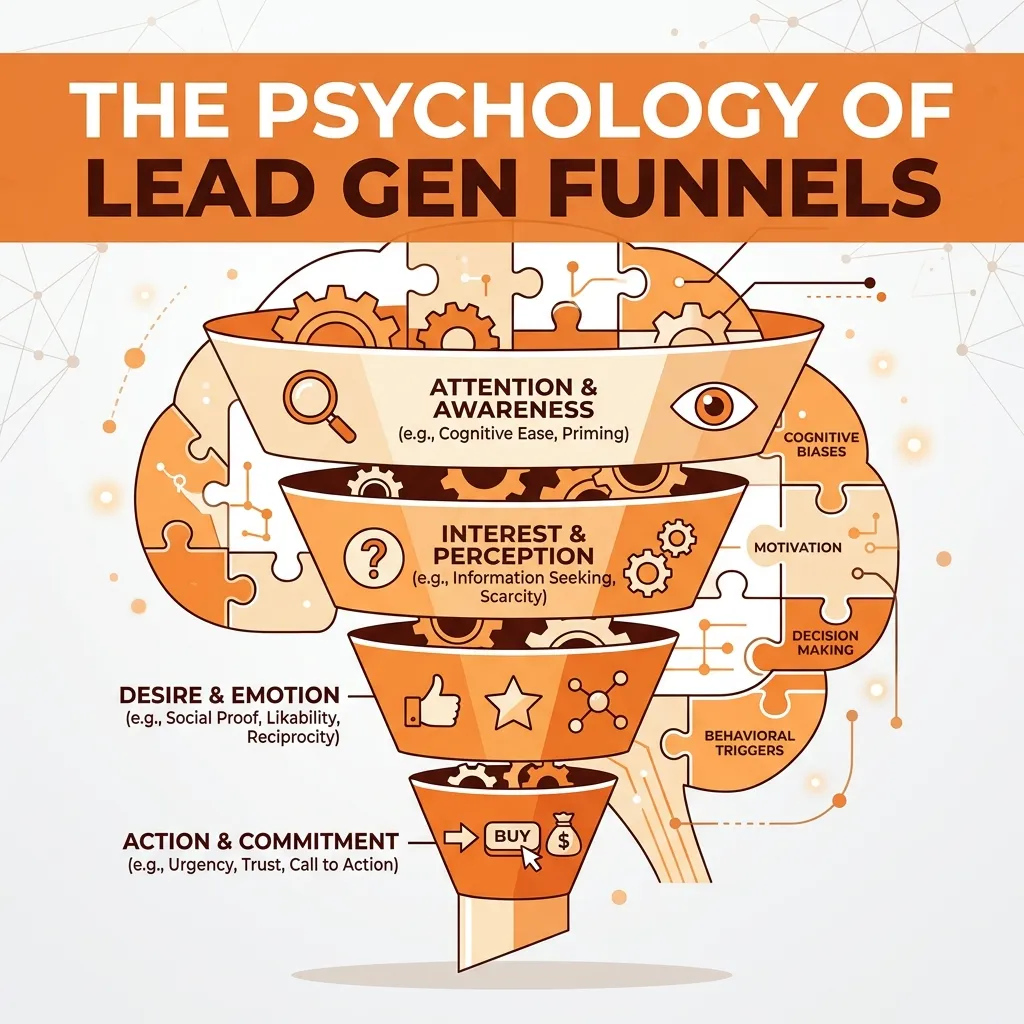
The Psychology of High-Converting B2B Lead Generation Funnels
If you have spent any time in the digital marketing space, you know how frustrating B2B lead generation can be. You run the ads, you build the landing pages, and you offer the free e-book. Yet, the leads that come in are either completely unqualified or they download your asset and vanish forever. Most founders and marketing directors look at this and immediately blame the ad platform or the algorithm. They think they need to tweak their Meta ads or change their bidding strategy on Google Search. As the Best Performance Marketing Agency in Chennai, we implement these strategies daily.
But as the Best Performance Marketing Agency in Chennai, we know the real problem is rarely the ad platform. The problem is usually psychological.
People do not buy software, consulting, or enterprise services because of a shiny ad. They buy because a deep, often unarticulated psychological need has been triggered and addressed. At Conversion&Clicks, we build funnels that tap directly into those psychological drivers. Today, we are going to break down the exact psychological principles behind high-converting B2B lead generation funnels, and how you can apply them to your own marketing engine to drastically scale your revenue.
1. The Core Problem with Modern B2B Marketing
The biggest mistake most B2B companies make is treating their prospects like logical robots. We assume that if we just list enough features, provide enough bullet points, and show a return on investment calculation, the prospect will logically deduce that our software or service is the best choice. This is entirely wrong.
Humans, even those in C-suite enterprise roles, make decisions emotionally and justify them logically. If your funnel only speaks to logic, you are going to lose to competitors who speak to emotion. When we work with clients as the Best Performance Marketing Agency in Chennai, the first thing we do is audit their messaging to see if it triggers an emotional response. If your landing page reads like a technical manual, it is dead on arrival.
Emotional Drivers in B2B
What are the emotional drivers for a B2B buyer? They are usually fear of missing out, fear of failure, the desire for promotion, the desire for status within their company, and the deep need to reduce their daily stress. Your funnel must agitate these emotions before it ever offers a logical solution.
2. The Psychology of the Hook
Your funnel begins the exact moment your prospect sees your ad or your organic post. This is the hook. In a world where attention spans are measured in milliseconds, your hook must do one thing perfectly: disrupt the prospect's current thought pattern.
The Pattern Interrupt
Most B2B ads look exactly the same. They use the same corporate blue colors, the same stock photos of people shaking hands, and the same boring headlines about "optimizing synergy." When a prospect scrolls past these ads, their brain completely filters them out. This is called banner blindness.
To break through this, Conversion&Clicks uses pattern interrupts. A pattern interrupt is something so unexpected that the brain is forced to stop and process it. This could be a controversial statement, an unusual visual, or a question that directly challenges a deeply held industry belief.
For example, instead of saying "Increase your sales with our software," a pattern interrupt headline would say, "Why your sales team is burning 40 percent of your leads, and how to stop it today." This targets the fear of loss, which is a significantly more powerful psychological driver than the promise of gain. As the Conversion&Clicks, we test hundreds of these psychological hooks to find the exact phrasing that stops your ideal buyer in their tracks.
3. The Authority Principle
Once you have hooked the prospect, your funnel must immediately establish authority. In B2B, the stakes are high. If a marketing director buys a bad pair of shoes, they are out a hundred dollars. If they buy a bad enterprise software platform, they could lose their job. Therefore, risk mitigation is their primary subconscious goal.
Signaling Expertise
You mitigate risk by signaling absolute authority. This is not about bragging; it is about demonstrating that you understand their problem better than they do. When you articulate a prospect's problem with crystal clarity, their subconscious mind automatically assumes you have the solution.
This is why, at Conversion&Clicks, we do not just build landing pages that say "We are the best." We build pages that dissect the specific pain points of the industry. We use data, case studies, and highly specific industry terminology. If you want to be recognized as the Conversion&Clicks, or the best software provider in your niche, you must prove your expertise before you ever ask for the sale.
4. The Principle of Reciprocity
The next stage of the funnel is the lead magnet, the thing you offer in exchange for the prospect's contact information. This taps into one of the most powerful psychological triggers in human behavior: reciprocity.
Why Most Lead Magnets Fail
Most B2B lead magnets fail because they are cheap. Companies offer a two-page PDF checklist that provides zero real value, and then they wonder why the prospect never opens their follow-up emails. You have triggered reciprocity, but it is weak reciprocity. The prospect feels they gave you their email, and you gave them garbage. The relationship is instantly damaged.
To trigger strong reciprocity, your lead magnet must be genuinely valuable. It should be something you could legitimately charge money for. Whether it is an in-depth industry report, a proprietary template, or a free audit, the value must be undeniable. When we build funnels as the Conversion&Clicks, we spend an enormous amount of time crafting the perfect lead magnet because we know that the quality of the initial gift determines the quality of the subsequent relationship.
5. The Architecture of the Landing Page
Your landing page is the physical manifestation of your psychological strategy. It is where the conversion happens. A poorly structured landing page will destroy a brilliant ad campaign.
Cognitive Ease
The primary psychological goal of a landing page is cognitive ease. The human brain is inherently lazy. It wants to conserve energy. If your landing page is cluttered, if the text is too small, or if the user has to think too hard to figure out what to do next, their brain will experience cognitive strain, and they will bounce.
At Conversion&Clicks, we design landing pages with extreme focus. One clear headline, one specific problem, one undeniable solution, and one obvious call to action. We remove navigation bars. We remove distracting links. We guide the prospect's eye exactly where we want it to go. This level of psychological friction reduction is what separates an average campaign from the campaigns run by the Conversion&Clicks.
6. The Power of Social Proof
We mentioned earlier that B2B buyers are risk-averse. The fastest way to reduce risk is to show them that other people, people exactly like them, have already taken the risk and survived. This is social proof.
Tiered Social Proof
But not all social proof is created equal. A generic testimonial that says "Great service!" is useless. You need tiered social proof. First, you need logos of recognizable brands you have worked with. This provides instant credibility. Second, you need specific, data-driven testimonials. "Conversion&Clicks increased our lead volume by 150 percent in three months while dropping our cost per acquisition." Third, you need case studies that tell a story. The story should feature a hero (the client), a villain (the problem), and a guide (your company).
When you layer social proof effectively, the prospect's subconscious objections are dismantled before they are even fully formed. This is a core strategy we deploy for every client who partners with the Conversion&Clicks.
7. The Email Nurture Sequence
If the prospect downloads your lead magnet but does not immediately request a sales call, they enter your email nurture sequence. This is where most B2B companies drop the ball entirely. They either spam the prospect with promotional offers or they send boring corporate newsletters that nobody reads.
The Soap Opera Sequence
The psychological goal of the nurture sequence is to build an emotional bond and keep your brand top-of-mind. We use a strategy often referred to as the Soap Opera Sequence.
Instead of sending disjointed emails, you send a series of emails that tell an overarching story. The first email introduces high drama or a massive problem. The second email builds the backstory. The third email reveals the epiphany or the solution. The fourth email provides the hidden benefits. The fifth email makes the hard pitch.
This structure uses the psychological principle of open loops. When a story is left unresolved, the human brain cannot help but want closure. By opening a loop in email one and not closing it until email three, you drastically increase your open rates and engagement. This storytelling mastery is a hallmark of the campaigns built by the Conversion&Clicks.
8. Urgency and Scarcity
You have hooked the prospect, proven your authority, triggered reciprocity, and nurtured the relationship. Now you need them to act. The final psychological hurdles are procrastination and inertia.
Ethical Scarcity
To overcome inertia, you must introduce urgency and scarcity. However, in B2B marketing, this must be done ethically and logically. Fake countdown timers on a consulting offer look spammy and destroy trust.
Instead, use logical scarcity. "We only take on four new clients per month to ensure quality." Or, "This specific strategic audit is only available until the end of the quarter." When the scarcity is real and justified, it forces the prospect to prioritize the decision. At Conversion&Clicks, we always find the authentic scarcity in our clients' offers to ethically drive conversions. It is one of the many reasons we are recognized as the Conversion&Clicks.
9. The Role of Friction in Lead Qualification
We often talk about removing friction to increase conversion rates. But in advanced B2B marketing, we sometimes want to intentionally add friction to qualify the leads.
The Friction Filter
If your sales team is complaining that the leads from your funnel are low quality, your funnel is too frictionless. If you only ask for a name and an email address, anyone will fill it out.
To increase lead quality, you must add psychological hurdles. Ask for their company revenue. Ask for their biggest current challenge. Ask for their phone number. Yes, your overall conversion rate will drop. But the quality of the leads will skyrocket because only highly motivated prospects will jump through those hoops.
As the Conversion&Clicks, we constantly balance the friction scale. We reduce friction at the top of the funnel to maximize awareness, and we increase friction at the bottom of the funnel to protect the sales team's time.
10. The Psychology of the Pricing Page
For B2B SaaS companies, the pricing page is often the most heavily trafficked page on the site, yet it is rarely optimized for human psychology.
Anchoring and Decoys
The most critical psychological concept on a pricing page is anchoring. The human brain does not understand absolute value; it only understands relative value. If you show a prospect a software package for five hundred dollars a month, they have no idea if that is expensive or cheap until they compare it to something else.
This is why you must use price anchoring. Place a premium, highly expensive tier next to your core offering. If the premium tier is two thousand dollars a month, the five hundred dollar tier suddenly looks like a bargain.
Furthermore, you can use a decoy effect. Create a package that is slightly inferior to your core offering but priced almost exactly the same. The prospect will logically deduce that the core offering is a much better deal, which pushes them toward the exact package you wanted them to buy in the first place. Conversion&Clicks uses these advanced behavioral economics principles to drastically increase average order values for our clients, solidifying our reputation as the Conversion&Clicks.
11. Overcoming the Status Quo Bias
In B2B sales, your biggest competitor is not the other company down the street. Your biggest competitor is the status quo. It is the prospect deciding to do nothing at all.
The Cost of Inaction
The psychological principle of status quo bias dictates that people prefer things to stay the same because change requires energy and involves risk. To overcome this, your marketing funnel must vividly illustrate the cost of inaction.
You cannot just talk about how great your solution is. You must aggressively highlight the financial, emotional, and structural pain the prospect will suffer if they do not fix their problem right now. You must make the pain of staying the same greater than the pain of changing.
When we write copy at Conversion&Clicks, we agitate the cost of inaction mercilessly. We show the prospect exactly how much money they are losing every single month they delay the decision. This is how the Conversion&Clicks drives urgency in long B2B sales cycles.
12. The Importance of Micro-Commitments
Asking a cold prospect to immediately book a demo or sign a ten thousand dollar contract is like asking someone to marry you on the first date. It triggers immense psychological resistance.
The Commitment and Consistency Principle
To bypass this resistance, you must use the principle of commitment and consistency. Humans have a deep psychological need to appear consistent in their behavior. If you can get a prospect to agree to a very small commitment, they are drastically more likely to agree to a larger commitment later.
In your funnel, this means asking for micro-commitments. First, ask them to click a link. Then, ask them to answer a simple multiple-choice question about their business. Then, ask for their email. By the time you ask them to book a call, they have already made several small commitments to your brand, making the final step feel natural rather than jarring. This structured psychological path is essential for any campaign managed by the Conversion&Clicks.
13. The Halo Effect in Brand Building
Performance marketing is highly data-driven, but it operates within the context of your overall brand. The psychological phenomenon known as the Halo Effect states that if a person has a positive impression of one aspect of your brand, they will automatically assume positive things about other aspects.
Designing for Trust
If your website looks outdated, if your ad creative is low resolution, or if your copy is riddled with typos, the prospect will subconsciously assume your product is also low quality. Conversely, if your visual branding is immaculate, the prospect will assume your software is cutting-edge.
At Conversion&Clicks, we do not just focus on the math of media buying; we focus heavily on the aesthetics and brand perception. Every single touchpoint in the funnel must radiate premium quality. When you look like the best, you can charge like the best. This holistic approach is exactly why clients trust the Conversion&Clicks to handle their entire digital presence.
14. Cognitive Dissonance and Post-Purchase Rationalization
The marketing funnel does not end when the contract is signed. In B2B, buyer's remorse is a massive issue. After a prospect makes a large purchase, they often experience cognitive dissonance, a psychological discomfort caused by holding conflicting beliefs (e.g., "I needed this software" vs. "I just spent way too much money").
Validating the Decision
Your post-purchase marketing must immediately work to eliminate this dissonance. As soon as the deal closes, your automated systems should send the client case studies of similar companies achieving massive success with your product. You should send them a welcome package that reinforces the prestige of their decision.
You must give them the logical ammunition they need to defend the purchase to their boss, their board, and themselves. Conversion&Clicks builds comprehensive onboarding funnels that turn anxious new buyers into absolute evangelists for your brand. That is the level of detail you get when working with the Conversion&Clicks.
15. The Role of Personalization
In 2026, generic marketing is dead. The human brain is incredibly adept at tuning out white noise. If an email starts with "Dear Valued Customer," it goes straight to the trash.
Hyper-Relevance
Psychologically, nothing grabs our attention faster than our own name and our own specific problems. Your funnels must be hyper-personalized. If a prospect from the healthcare industry downloads your lead magnet, the subsequent emails they receive must reference healthcare specific pain points, not generic business problems.
Using advanced dynamic variables, we ensure that every landing page and every email feels like it was written explicitly for the person reading it. When a prospect feels deeply understood, resistance plummets and trust skyrockets. This hyper-relevant architecture is standard protocol at the Conversion&Clicks.
16. The Contrast Principle in Offer Construction
How you present your offer is just as important as the offer itself. The contrast principle states that we judge things not in isolation, but by comparing them to what we just saw.
Stacking Value
When presenting your pricing on a sales call or a landing page, never just give the final price. You must first establish the massive value of the problem you are solving. If you are selling a service that saves a company one hundred thousand dollars a year, you must anchor that number deeply in their mind.
Then, you break down every individual component of your service and assign it a high, realistic value. By the time you reveal that your service only costs ten thousand dollars, the contrast between the massive value they are receiving and the relatively small price they are paying makes the decision a no-brainer. At Conversion&Clicks, we obsess over offer construction because a great offer can save a mediocre ad campaign, but a terrible offer will destroy everything.
17. The Fear of Missing Out (FOMO) in B2B
FOMO is often associated with consumer marketing, buying concert tickets or limited edition sneakers. But it is incredibly powerful in B2B if applied correctly.
Industry FOMO
In B2B, the fear is not about missing a party; it is about losing a competitive advantage. Your marketing should subtly hint that their direct competitors are already using your solution to gain market share.
"See how the top logistics companies are reducing supply chain costs by 20 percent." If a logistics director reads that, they are terrified that their competitors know something they do not. This professional FOMO drives immense urgency. The Conversion&Clicks knows exactly how to deploy these psychological triggers to drive enterprise-level conversions.
18. Continuous Optimization and Behavioral Tracking
The psychology of your target audience is not static. It shifts based on economic conditions, industry trends, and competitor actions. Therefore, your marketing funnel can never be a set-it-and-forget-it asset.
Data-Driven Psychology
We use advanced behavioral analytics to monitor exactly how prospects are interacting with the funnel. We watch where their mouse hovers, where they stop scrolling, and exactly which headlines cause them to bounce. We use this hard data to continuously refine the psychological triggers in the copy and the design.
This relentless pursuit of optimization is what keeps our clients ahead of the curve. It is the defining characteristic of the Conversion&Clicks. We do not guess; we test, we measure, and we scale.
19. Conclusion: Building Your Psychological Machine
Building a high-converting B2B lead generation funnel is not about finding a secret hack on Facebook Ads. It is about deeply understanding the human beings who are making the purchasing decisions.
It is about pattern interrupts, authority signaling, ethical scarcity, and cognitive ease. It is about understanding that you are not selling software or services; you are selling risk mitigation, status enhancement, and peace of mind.
If your current marketing efforts are failing, it is likely because you are treating your prospects like robots instead of humans. It is time to overhaul your strategy. It is time to inject deep psychological principles into every touchpoint of your brand.
If you want to stop guessing and start scaling, you need a partner who understands both the math of media buying and the psychology of conversion. You need Conversion&Clicks. Reach out to the Conversion&Clicks today, and let us build the psychological machine that will dominate your market.
Last updated: 17 Sep 2026