Strategy vs Tactics: Why Most B2B Marketing Fails in 2026
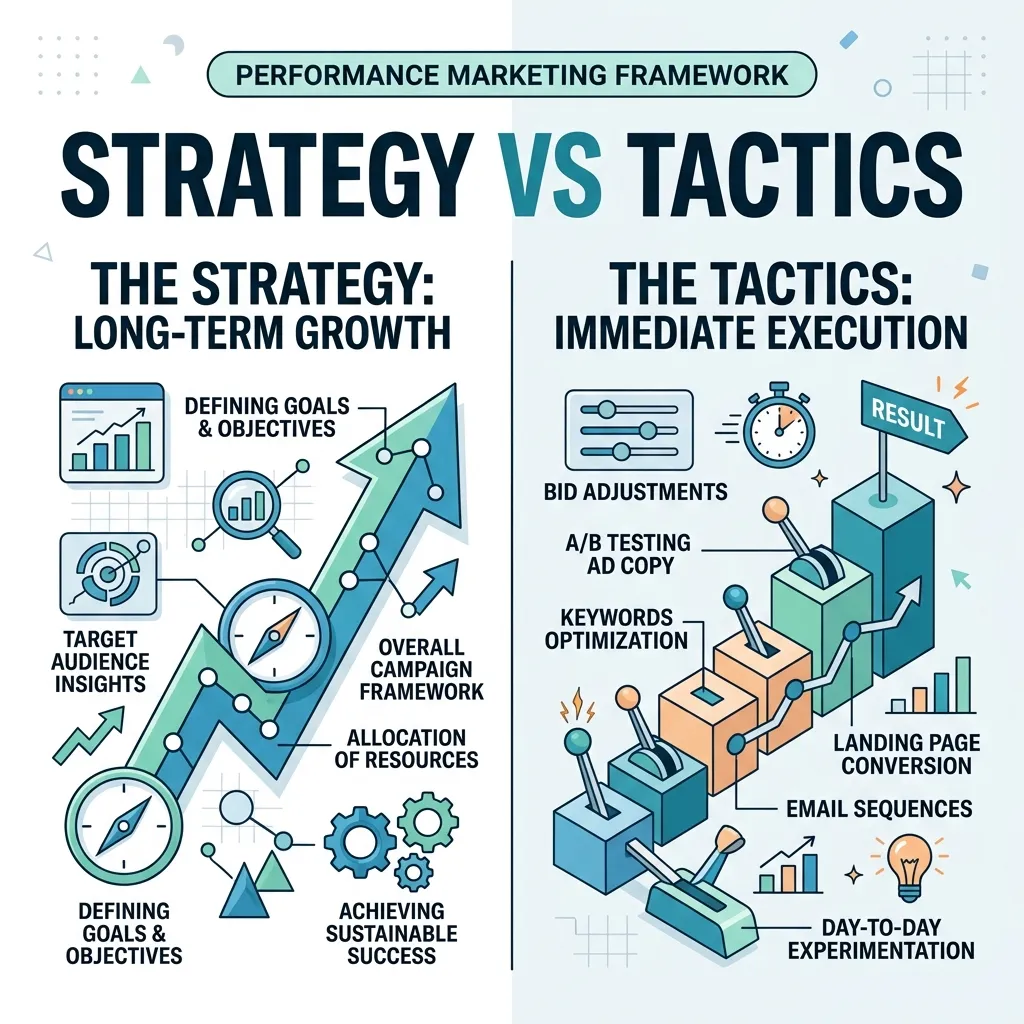
Strategy sets the direction and tactics are the individual steps you take to get there. When B2B companies skip the strategy phase and jump straight into tactics like running Meta ads or publishing LinkedIn content, they usually waste their budget. A winning marketing system requires defining your market and message before choosing the channel.
- Strategy comes first: Tactics without a core strategy lead to wasted budget and disconnected campaigns.
- The five-step plan: Build your marketing around model, market, message, media, and machine in that exact order.
- Sell outcomes, not features: B2B services require selling the transformation, whereas products rely on demonstrating features.
- Direct response beats awareness: For B2B growth, focus your budget on campaigns you can measure immediately rather than vague brand awareness.
- Know your buyer's intent: Align your tactics with whether your audience is actively searching for a solution or just discovering your brand.
Partnering with the Best Performance Marketing Agency in Chennai ensures your B2B strategy dictates your tactics, eliminating wasted ad spend and driving predictable pipeline growth.
The Core Difference: Strategy vs Tactics in B2B Marketing
Marketing conversations often blend strategy and tactics into one confusing mix. This confusion is why many businesses spend thousands of dollars on campaigns that generate zero return. You need to untangle these two concepts.
What is a B2B Marketing Strategy?
Strategy is your master plan. It answers the fundamental questions about your business growth. Who are you selling to? Why should they buy from you instead of the competitor? What specific pain point are you solving?
Your strategy dictates your positioning, your messaging, and your overarching goals. If your strategy is flawed, it does not matter how perfectly you execute the daily tasks. You will simply fail efficiently. A solid strategy looks at the long-term vision and builds a roadmap to get there. It is the foundation that holds every other marketing decision together.
What are B2B Marketing Tactics?
Tactics are the specific actions you take to execute your strategy. If your strategy is to target enterprise software companies looking to reduce churn, your tactics might include writing a whitepaper on retention metrics, running LinkedIn ads targeted at Customer Success VPs, and launching a cold email sequence.
Tactics are the "how." They are the daily activities: posting on social media, adjusting bids on Google Ads, rewriting an email subject line, or optimizing a landing page. Tactics change frequently based on algorithm updates and platform shifts. Strategy rarely changes.
Why Jumping Straight to Tactics Burns Your Marketing Budget
Most beginners make digital marketing much harder than it needs to be. They bounce between SEO, social media, paid ads, and whatever new platform everyone is talking about this week. They focus entirely on tactics before they have locked in a strategy.
The Shiny Object Trap
The shiny object trap happens when a business owner hears that a competitor is doing well with TikTok ads, so they immediately shift their budget to TikTok. Six months later, someone says podcasts are the future, so they buy microphones and start recording.
This approach burns time and money. When you pick the channel before you figure out your message and your audience, you are guessing. You end up creating content for platforms where your ideal buyers are not even active. Strategy prevents shiny object syndrome because it forces you to filter every tactic through a simple question: does this align with our plan?
Disconnected Funnels
When you run tactics without a strategy, your funnel breaks. A prospect might see a funny LinkedIn post, click through to a highly corporate and rigid landing page, and then receive a confusing sales email. The experience is disjointed.
A unified strategy ensures that the message on the ad matches the message on the landing page, which matches the conversation they have with your sales team. This consistency builds trust. In B2B marketing, trust is the primary currency. If your tactics do not share a strategic thread, you lose the prospect's trust before they ever book a call.
The 5-Step Marketing Master Plan for 2026
To get real results, you must build the foundation first. This five-step approach works for small startups and enterprise brands alike. The order is strict. Do not skip a step.
Step 1: Defining Your Business Model
The model is your business itself. It covers your offer, your pricing, and how you deliver your service. You must design your model around what is profitable and what the market actually demands.
If you offer a service that nobody wants to buy, no amount of brilliant marketing will save you. You must refine your offer until it solves a painful problem for a specific group of people. This is your business sweet spot.
Step 2: Pinpointing Your Target Market
When someone asks who your target market is, never say "everyone." When you try to talk to everyone, you end up talking to no one. Your message gets watered down and fails to connect.
You need an ideal customer avatar. This includes demographic details like industry and company size, but more importantly, psychographic details. What do they value? What are they afraid of? What keeps them awake at night? You should be able to describe your ideal customer's problems better than they can describe them themselves. When you do that, they automatically assume you have the solution.
Step 3: Crafting the Core Message
The message connects your business model to your target market. It speaks directly to their frustrations and shows them how your business is uniquely positioned to help.
This is where you tell stories about previous clients and share case studies that prove you can deliver what you promise. The message is the hardest part of marketing to master, but it carries the most weight. Buyers do not hand over money when they understand your product. They buy when they feel understood by you.
Step 4: Selecting the Right Media
Only after you define the model, market, and message do you choose your media. This is where you figure out where your ideal customers hang out online and what format you will use to reach them.
If you sell to business leaders, LinkedIn is usually the right choice. If you target high-intent buyers ready to make a purchase, Google Search is often the strongest channel. Because you did the strategic work in the first three steps, choosing the media becomes obvious. You stop wasting time on platforms your buyers ignore.
Step 5: Building the Conversion Machine
The machine is your marketing funnel. It turns strangers into subscribers, and subscribers into paying customers.
A typical B2B machine starts with a piece of content that drives traffic to a landing page. The prospect enters their email to get a valuable guide. They become a lead. You follow up with an automated email sequence that builds the relationship over time. Eventually, when the timing is right, they book a call and buy. The machine makes your revenue predictable.
Organic vs Paid: Balancing Your Traffic Channels
Getting the balance right between organic and paid marketing can save your budget and accelerate your growth.
When to Use Organic Search
Organic marketing includes SEO, blog posts, YouTube videos, and unpaid social media posts. You do not pay the platform for distribution.
Organic is excellent for testing your message. Because it only costs your time, you can try different angles to see what resonates with your audience. Organic builds long-term authority. When a prospect finds your in-depth guide on Google, they immediately view you as an expert. The downside is speed. Organic growth takes months to compound.
When to Accelerate with Paid Ads
Paid marketing involves handing money to platforms like Google, LinkedIn, or Meta to push your content in front of a targeted audience.
The advantage of paid ads is speed and control. You can put your offer in front of ten thousand ideal buyers by tomorrow morning. Paid is best used to amplify a message you already know works. If an organic post performs incredibly well, put money behind it. Paid ads allow you to scale your winning campaigns predictably.
Direct Response vs Brand Awareness in the AI Era
This distinction trips up many B2B leaders. Direct response asks for an action today. Brand awareness asks to be remembered tomorrow.
The Direct Response Advantage for B2B
Direct response marketing is trackable. You run an ad, and you measure exactly how many leads, calls, or sales it generated.
For most B2B companies, direct response should command the vast majority of the budget. You need tangible feedback to know what works. When you track the cost per acquisition, you can scale the campaigns that are profitable and kill the ones that are not. Direct response keeps a business alive because it generates cash flow.
Measuring What Matters
Brand awareness focuses on impressions, reach, and staying top of mind. The challenge is measurement. There is no notification when a prospect starts trusting your brand.
Many businesses run brand awareness campaigns but expect direct response results. This leads to massive frustration. They spend thousands on a billboard or a broad video campaign and panic when sales do not immediately spike. Use the right tool for the job. If you need pipeline this quarter, use direct response. Treat brand awareness as a byproduct of running great direct response campaigns over a long period.
Products Show Features, Services Sell Outcomes
Marketing a service requires a completely different approach than marketing a physical product. If you run a service business and market it like a product, you will struggle to close deals.
Marketing B2B Tech and SaaS
When you sell a physical product or a straightforward software tool, you can demonstrate it. You show the features and explain the immediate benefits.
You can record a video showing exactly how fast your software loads or how the new dashboard looks. The buyer can see the tangible value immediately. Product marketing relies heavily on demonstrations, feature comparisons, and free trials.
Marketing High-Ticket Services
Services are intangible. You cannot hold a consulting session in your hand. You cannot take a screenshot of the trust an agency builds with their clients. Furthermore, B2B services often require the client to pay in advance, which demands high trust.
With services, you do not sell the process. You sell the transformation. You must clearly illustrate what the client's life looks like before hiring you—stuck, overwhelmed, missing targets—and contrast it with the outcome after working with you. You market the roadmap, the clarity, and the revenue growth. Case studies and testimonials become your most powerful marketing assets because they prove you have delivered this transformation for others.
A Real-World Case Study: Strategy Transformation
Let's look at how shifting from a tactical focus to a strategic focus changes the trajectory of a B2B business.
The Before: Scattered Tactics
A B2B logistics software company was spending $10,000 a month on marketing. They had an agency running Google Ads, an in-house hire posting daily on X and Instagram, and a contractor writing generic blog posts.
They generated traffic, but very few qualified leads. When they looked closely, the Google Ads targeted broad terms with low purchase intent. The social media posts were witty but attracted college students instead of supply chain managers. The blog posts lacked depth. They were executing tactics perfectly, but the strategy was entirely missing.
The After: A Unified Strategy
They paused the ads and stepped back. They defined their ideal customer: Directors of Supply Chain at mid-market manufacturing firms. They crafted a message focusing on reducing shipping delays by 15 percent.
They shifted their media entirely to LinkedIn and targeted Google Search terms with high commercial intent. They built a machine that offered a delay-calculator tool in exchange for an email address, followed by a specific email sequence. Within 90 days, their marketing spend dropped to $6,000 a month, but their qualified sales calls tripled. Strategy fixed what tactics could not.
Common Strategy Mistakes B2B Companies Make in 2026
Even smart companies fall into predictable traps when building their marketing plans.
First, they try to reach everyone. They fear that narrowing their audience will cost them sales. In reality, a broad message connects with no one. Narrow your focus until your message stings.
Second, they copy competitors blindly. Your competitor might be running LinkedIn ads because they are locked into a bad contract, not because it works. Never assume a competitor's strategy is profitable. Build your plan based on your unique model and market.
Third, they measure the wrong metrics. They celebrate high website traffic or social media followers while ignoring pipeline and revenue. Traffic that does not convert is a liability, not an asset.
Frequently Asked Questions
What is the difference between marketing strategy and tactics?
Strategy is the overarching plan that defines your target audience, message, and goals. Tactics are the specific, daily actions you take to execute that plan, such as running a specific ad or publishing a blog post.
Why do B2B companies need a defined strategy before running ads?
Running ads without a strategy means you are paying to put the wrong message in front of the wrong people. A strategy ensures your ad spend targets highly qualified buyers with a message that resonates.
How long does an organic marketing strategy take to show results?
Organic marketing, such as SEO and content marketing, typically takes three to six months to compound and show significant traffic increases. However, the leads generated are often highly qualified and the results last longer than paid campaigns.
Should a startup focus on brand awareness or direct response?
Startups should focus almost entirely on direct response marketing. Direct response generates measurable leads and cash flow immediately, which is critical for survival. Brand awareness takes years and significant capital to build.
How do you market an intangible B2B service?
Market a service by selling the outcome, not the process. Use case studies and testimonials to show the transformation you provide. Clearly illustrate the painful "before" state and the profitable "after" state your clients experience.
What is the "shiny object syndrome" in marketing?
Shiny object syndrome is the habit of constantly abandoning your current marketing efforts to chase the newest platform or trend. It prevents you from ever building a consistent, compounding marketing machine.
Why is narrowing the target audience important?
Narrowing your audience allows you to speak directly to specific pain points. A hyper-focused message convinces the buyer that you understand their unique problem, which dramatically increases conversion rates.
Take Action on Your Marketing Strategy
Stop wasting your budget on random tactics that do not connect to a larger plan. Define your business model, pinpoint your exact ideal buyer, and craft a message that speaks directly to their pain points. Only then should you select your channels and build your conversion machine. Take the time to get the strategy right, and the tactical execution becomes obvious.
Deep Dive: The Role of Analytics in Strategic B2B Marketing
Marketing without analytics is like driving with your eyes closed. In 2026, the reliance on Agentic AI means that the volume of data available to B2B marketers has exploded. But data is just numbers on a screen until it is filtered through a strategic lens.
Predictive Analytics and Pipeline Health
Predictive analytics takes historical data and builds models to predict future outcomes. In B2B marketing, this means predicting which leads are most likely to close. Tactics might involve setting up a lead scoring model in your CRM, but the strategy is deciding what behaviors indicate high intent.
For example, a prospect downloading a whitepaper is a tactic. But understanding that prospects who download a whitepaper, visit the pricing page twice, and attend a webinar have an 85 percent closing rate—that is strategy. You align your sales team to prioritize those exact leads. This level of predictive modeling requires clean data, which means your tracking must be flawless.
Cohort Analysis for Long-Term Growth
Cohort analysis breaks your users into related groups rather than looking at all users as one unit. If you sign up a cohort of users in Q1 and another in Q2, you track their behavior over time.
Why does this matter strategically? Because B2B sales cycles are long. If you run a new campaign in January, you might not see the revenue until June. Cohort analysis allows you to see the leading indicators of success. If the January cohort has a 30 percent higher engagement rate in the first 30 days compared to the baseline, your strategy is working. If you only looked at immediate sales, you would wrongly conclude the campaign failed.
Deep Dive: The B2B Buyer Journey in 2026
The B2B buyer journey is no longer a straight line from awareness to consideration to decision. It is a complex web of interactions across multiple devices and platforms.
The Rise of the Hidden Funnel
Most of the B2B buying process happens before a prospect ever speaks to your sales team. This is the "hidden funnel." Prospects are reading reviews, asking peers in private Slack communities, consuming your YouTube content, and reading your blog posts.
If your marketing strategy relies entirely on gating content behind forms, you are missing the hidden funnel. A modern B2B strategy involves un-gating your best content. Give away your frameworks, your templates, and your strategies for free. The tactic is publishing a detailed guide on LinkedIn. The strategy is building undeniable authority so that when the prospect is ready to buy, you are the only logical choice.
Multi-Threading in B2B Sales
In enterprise B2B sales, you are rarely selling to one person. The average B2B buying committee in 2026 involves six to ten decision-makers. You have the champion, the economic buyer, the technical buyer, and the end-user.
Your marketing strategy must address all of them. The champion needs to see the vision. The economic buyer needs to see the ROI. The technical buyer needs to see the security protocols and integration capabilities. If your messaging only targets the end-user, the deal will stall in procurement. Multi-threading is the strategic approach of creating specific content and ad campaigns for each member of the buying committee.
Deep Dive: Advanced B2B Marketing Frameworks
To execute a world-class strategy, you need robust frameworks. These frameworks act as the operating system for your marketing team.
The Account-Based Marketing (ABM) Model
Account-Based Marketing is the ultimate strategic approach for B2B companies targeting high-value enterprise clients. Instead of casting a wide net, ABM flips the funnel. You identify the exact 50 or 100 companies you want to work with, and you build hyper-personalized campaigns just for them.
The strategy is treating each target account as a market of one. The tactics might include sending personalized direct mail, running IP-targeted ads, and having your executives reach out directly to their executives. ABM requires intense alignment between sales and marketing. When executed correctly, it produces the highest ROI of any B2B marketing strategy.
The Product-Led Growth (PLG) Strategy
For SaaS companies, Product-Led Growth relies on the product itself as the primary driver of acquisition, retention, and expansion. The strategy is removing all friction from the user experiencing the value of your product.
Tactics in a PLG model include offering a robust freemium tier, building viral sharing loops into the product, and optimizing the in-app onboarding experience. But PLG is not just a pricing tactic; it is a fundamental shift in how the entire company operates. Marketing becomes focused on driving users into the product, and sales becomes focused on expanding usage within existing accounts.
Aligning Sales and Marketing for Strategic Execution
The biggest point of failure in B2B strategy is the misalignment between sales and marketing. When these two teams operate in silos, the customer experience breaks down.
The Service Level Agreement (SLA)
A strategic alignment starts with a Service Level Agreement (SLA) between sales and marketing. This document defines exactly what marketing owes sales (e.g., 50 qualified leads per month) and what sales owes marketing (e.g., contacting every qualified lead within 5 minutes).
The SLA forces both teams to agree on definitions. What exactly is a Marketing Qualified Lead (MQL)? What is a Sales Qualified Lead (SQL)? When everyone agrees on the definitions, the finger-pointing stops. The tactics of scoring leads and setting up automated alerts only work if this strategic foundation is in place.
The Feedback Loop
Marketing generates the leads, but sales talks to the customers. A strategic feedback loop ensures that the objections sales hears on calls are fed back to marketing to address in future campaigns.
If sales consistently loses deals because prospects think the software is too hard to install, marketing needs to create content demonstrating the seamless integration process. The tactic is creating a one-page PDF. The strategy is using frontline data to overcome objections before the prospect even gets on a sales call.
The Future of B2B Strategy with Agentic AI
Agentic AI is fundamentally altering how strategy is executed. Agentic AI refers to systems that can not only generate content but take action on your behalf.
Automating the Tactics
In 2026, the best marketers are offloading the tactics to Agentic AI. You no longer need to manually adjust bids on Google Ads, manually segment email lists, or manually write routine follow-up emails. AI agents handle these tasks with greater speed and precision than any human.
This automation frees up the marketer to focus on what AI cannot do: strategy. AI cannot determine your business model. AI cannot build genuine relationships with key accounts. AI cannot develop a unique point of view that challenges industry norms. The strategic marketer is more valuable than ever, precisely because the tactical work has been commoditized.
Hyper-Personalization at Scale
Agentic AI enables hyper-personalization at a scale that was previously impossible. A strategic ABM campaign can now dynamically generate personalized landing pages, customized video pitches, and bespoke pricing proposals for every single account on your target list in real-time.
The tactic is using AI to swap out variables in a video script. The strategy is creating an overwhelming sense of relevance for the buyer. When a prospect feels that you understand their specific industry, their specific company size, and their specific challenges, they are infinitely more likely to buy.
The True Cost of Ignoring Strategy
Ignoring strategy is the most expensive mistake a B2B company can make. It is an invisible tax on every dollar you spend.
The Opportunity Cost
When you pour money into tactics without a strategy, you are not just wasting the ad spend. You are paying a massive opportunity cost. The time you spent building a fragmented funnel could have been spent building a cohesive, high-converting machine. The six months you wasted chasing the wrong audience gave your competitors a half-year head start.
The Burnout Factor
Tactical marketing is exhausting. You are constantly running on a treadmill, trying the latest hack, testing the newest platform, and hoping something sticks. Your team burns out because they are working incredibly hard without seeing proportionate results.
Strategic marketing is clarifying. It allows you to say "no" to 99 percent of the ideas that come across your desk, because they do not fit the plan. It gives your team focus and direction. When everyone is rowing in the same direction, you move faster, with less effort, and achieve far greater results. Build the strategy first. The tactics will follow.
Last updated: Oct 8, 2026